

RP5: While US-Iran hostilities continue, Washington is inking very consequential deals
The Riyalpolitik 5 highlights five recent geo-economic developments across the Middle East that we’re keeping an eye on.
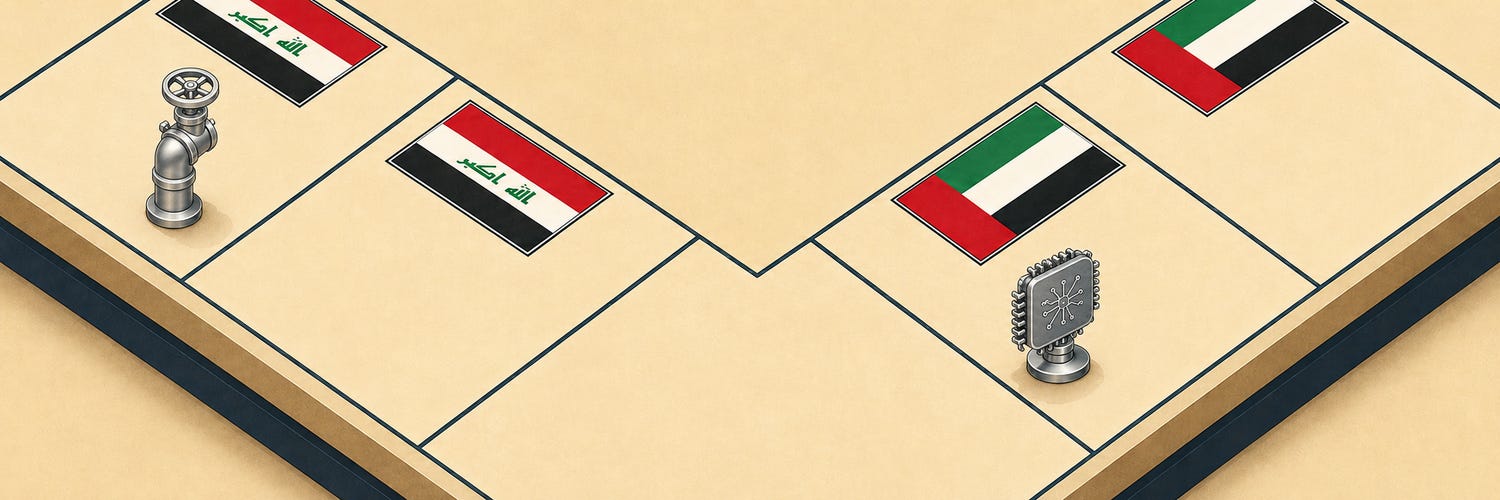
One Big Deal: While US-Iran hostilities continue, Washington is inking very consequential deals: With a deal between the US and Iran seeming as out of reach as ever, the US has been pursuing two very consequential deals in the region: a Hormuz-alternative pipeline and a major AI chips deal.
Why we care: The US-brokered agreement between Iraq and Syria aims to revive the Kirkuk–Baniyas pipeline — a 500-mile route from northern Iraq’s oil fields to Syria’s Mediterranean coast — backed by a US-led consortium including Chevron, TI Capital, and Qatar’s UCC Holdings, with an initial projected capacity of up to two million barrels per day. Previously dismissed as a geopolitical fantasy, the Kirkuk–Baniyas pipeline has been dormant since 2003, but has now been made viable by the same crisis that made it necessary. For Iraq, where oil normally accounts for approximately 90% of state revenue and virtually all of it moved previously through Hormuz, this infrastructure is existential. When this pipeline is up and running, it will reduce exposure to a chokepoint whose closure cut Iraq’s oil exports to less than a third of normal levels, costing Baghdad an estimated $128 million per day and triggering a $5 billion budget deficit in the first four months of the conflict alone. For Syria, it is a multi-billion dollar construction project — estimates range from $4.5 to $8 billion — and a key revenue stream for a country getting back on its feet. And for Washington, it is the infrastructure equivalent of a strategic declaration: the US intends to permanently reduce Iran’s ability to hold the region’s energy supply hostage by building around the chokepoint it has weaponized.
Also last week, the US Commerce Department upgraded the UAE to Country Group A:5, unlocking license-free access to advanced Nvidia chips, military-grade equipment, commercial satellites, and dual-use technologies, explicitly citing Abu Dhabi’s role as a security partner during the Iran war. The deal permits the UAE to import up to 500,000 advanced AI chips annually, with G42 and Core42 as the primary approved recipients. This bilateral technology partnership is deepening still: the US and UAE this week stood up a joint military AI task force, the first of its kind between Washington and a Gulf state, focused on integrating AI into defense systems, logistics, and battlefield decision-making.
Read together, Kirkuk-Baniyas and the UAE chip upgrade tell the same story. Washington is building alternative corridors in energy, data, and silicon, all meant to route around the chokepoints that the Iran war exposed. The pipeline diversifies energy away from Hormuz. The chip deal offers access to American technology as the reward for security alignment. Together, they are the clearest signal yet of what the post-war US regional economic strategy might actually look like.
One Policy Development: Washington’s Levant-Centric Diplomacy Has a Busy Week: In the span of four days, Iraqi Prime Minister ‘Ali al-Zaidi met Trump at the White House, Lebanese President Joseph Aoun became the first Lebanese head of state to visit Washington since 2009, and the US and Jordan signed a new Reciprocal Trade Agreement.
Why we care: Three meetings with three different leaders, each producing a concrete deliverable, in what amounts to the most concentrated burst of Levant-centric U.S. diplomacy in years. The three deals reveal a Trumpian pattern of transactional diplomacy. For decades, the U.S. treated security and economics in the Middle East as two parallel and separate tracks, but they are increasingly converging: trade, technology, project finance, and economic policy are now deployed alongside defense assistance to reward states that are moving in the direction it wants and structuring economic incentives to keep these alignments in place.
Iraq’s al-Zaidi left DC with over $60 billion in preliminary energy and infrastructure agreements with US companies. In parallel, he committed to a September 30 deadline for militia disarmament aligned with the final withdrawal of US coalition forces, a move designed to burnish his domestic credibility and to survive the political cost of dismantling groups embedded across the Iraqi state. Aoun’s meeting produced US support for the Lebanese Armed Forces and, hours later, Trump’s announcement that U.S. airlines could fly direct to Beirut for the first time since 1985. Lifting a ban that Ronald Reagan imposed after Hezbollah hijacked TWA planes at Beirut airport is Washington’s way of saying that Lebanon under Aoun is a different country today. And Jordan’s trade deal cuts its US tariff exposure from 20% to 10% and adds new provisions on digital trade and national security cooperation, cementing the kingdom’s role as a linchpin of the emerging Gulf-Mediterranean corridor.
One Source of Friction: The Region Now Has Two Active Chokepoints: The Houthis (remember them?) last week declared a naval blockade of the Bab el-Mandeb, immediately causing four tankers carrying 3.8 million barrels of Saudi crude to reroute, while Iran simultaneously resumed attacks on tankers in Hormuz, with a dozen ships struck since July 6 and two seafarers killed.
Why we care: Access to the region’s critical maritime export routes is deteriorating, and the strategic implications are severe. Saudi Arabia rerouted its entire export infrastructure to the Red Sea after Hormuz closed. The Bab el-Mandeb blockade now puts the Red Sea terminus at Yanbu, on Saudi’s Red Sea coast, directly in the Houthi threat envelope. This is likely not improvised, and rather the culmination of a deliberate double-chokepoint strategy: Iran controls Hormuz, its Houthi ally now threatens Bab el-Mandeb, and the Kirkuk–Baniyas pipeline alternative will not be operational for at least three years. As Reuters reported on July 16, Iran had been positioning this option as leverage — instructing the Houthis to stand ready to close Bab el-Mandeb entirely if the US struck Iranian power infrastructure, with IRGC representatives already in Yemen designated to control the timing of any closure. The ladder of escalation that the MOU was supposed to stop is still escalating. Iran and its proxy network can still threaten alternative routes that Washington and its Gulf allies build, in spite of Hormuz workarounds. That dynamic, more than any specific strike or incident, is a defining structural problem of this conflict and the hardest one to negotiate away.
One Under the Radar: Syria Gets Its First Real Banking Moment: Syria’s Central Bank and Finance Ministry hosted a joint workshop with Citibank in Damascus on July 16 to discuss dollar clearing and correspondent banking while an IMF mission simultaneously met Finance Minister Mohammed Yisr Barnieh in Damascus.
Why we care: Citibank’s Damascus workshop with Syrian officials was a clear signal that the US financial system is considering reconnecting with Syria. Because of the greenback’s role as the main international reserve currency, dollar clearing is the plumbing of international commerce: without it, foreign companies cannot repatriate profits, contracts cannot be priced, correspondent banking is nearly impossible, and trade finance cannot flow. The JPMorgan-Qatar reconstruction facility we covered last edition is only deployable if Syria has a functional banking system capable of receiving and disbursing capital at scale.
Earlier sanctions relief had already cut the license timeline for US exports to Syria from nine months to six weeks, with no rejections recorded, and President Trump formally initiated the additional step of rescinding Syria’s State Sponsor of Terrorism (SST) designation entirely. The Citibank workshop, the IMF mission, and the SST rescission process are all parts of the same story: building the financial infrastructure through which reconstruction capital, once committed, can actually move. It is also worth noting the week’s broader Syria picture: Visa appeared at the US-Syria Business Forum alongside Syrian ministers; ConocoPhillips was awarded a deal to develop Syrian gasfields; and US export license approvals are now running with no rejections since sanctions were largely lifted. The question is whether any of this converts into a Citibank correspondent banking relationship. That could mean that the door to Syria is not just ajar, but genuinely open for business. We are watching closely.
One Fun Thing: The Middle East Just Added Six UNESCO World Heritage Sites — Including Two in Countries Targeted by Iran: This week, UNESCO’s World Heritage Committee inscribed six new Middle Eastern sites at its 48th session in Busan, South Korea: Wadi Wurayah in Fujairah — the UAE’s first natural World Heritage site — Jordan’s Aqaba Marine Reserve, Iran’s Alamut Castle, the Tunisian village of Sidi Bou Said, Lebanon’s Mount Amel Castles, and the archaeological site of Sebastia in the West Bank.
Why we care: The list reads like a guided tour of the region’s most beautiful (and most contested) places simultaneously. The UAE’s Wadi Wurayah — a 22,000-hectare freshwater canyon in the Hajar Mountains harboring 883 animal species, including at least 10 globally threatened ones — was inscribed at the very moment Abu Dhabi was absorbing more Iranian drone strikes than any of its neighbors. Jordan’s Aqaba Marine Reserve, home to the world’s northernmost tropical coral reef and more than 500 fish species, sits at the foot of the same port city that Iran targeted with missiles this month. Lebanon’s Mount Amel Castles are five medieval fortifications in southern Lebanon that survived the Crusaders, the ‘Ayyubids, the Mamluks, and the Ottomans. They were inscribed through an emergency procedure and simultaneously placed on the List of World Heritage in Danger, because active conflict is damaging them right now. That dual designation captures something true about the region’s current state: the world is formally recognizing what the Middle East has built over millennia at the moment some of it is being destroyed. It is, in its own way, a precise summary of where the Middle East stands in July 2026: ancient, resilient, and under threat all at the same time.