

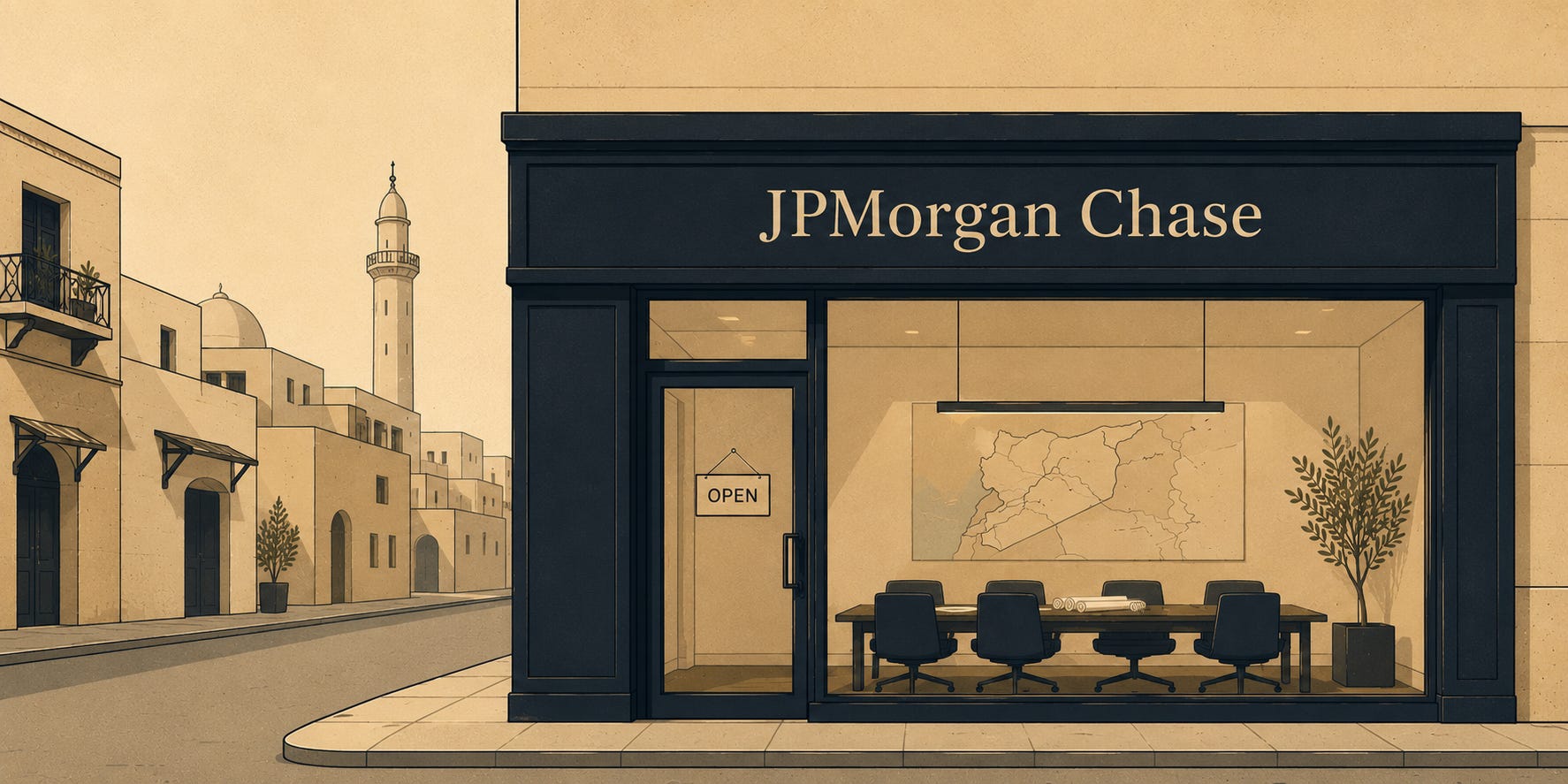
One Big Deal: JPMorgan bets on Syrian reconstruction, backed by Qatar: JPMorgan has joined Qatari and Emirati banks to arrange a $7 billion debt financing facility for Power International Holding, the massive Qatar-based conglomerate, to rebuild Syrian energy, water, and transportation infrastructure.
Why we care: This is one of the largest single foreign commitments to Syria’s reconstruction to date since Bashar al-Assad’s ouster. While the number matters, the more telling story is the name at the top of the syndicate. America’s largest bank by total assets and market cap underwriting reconstruction in Syria — a market that was effectively closed off from the Western-led financial system for decades — signals that despite its fragile transition, Syria’s reconstruction race is on.
This transaction also hints at what reconstruction financing will likely look like across the region. Gulf sovereign wealth funds and their affiliated companies supply the capital and mitigate the risk, while the participation of Western firms signal to international investors and companies that long-term prospects are real. Qatar National Bank, itself backed by the country’s sovereign wealth fund, is fully guaranteeing the facility from loss, the part of the deal structure that makes traditionally risk-averse US banks willing to join in. Qatar, already the first mover in Syria (as we’ve covered), further strengthens its strategic position in the country, which is now a site of competition between Saudi Arabia, the UAE, Türkiye, and Qatar. And JP Morgan gets a first-mover advantage in a highly desirable market. The real question is how much work is the Qatari guarantee doing: will companies move into Syria without de-risking or will reconstruction across the region only happen on the backs of GCC sovereign guarantees?
One Source of Friction: The Strait Is the MOU’s First and Most Immediate Test (and It Remains Fraught): The US-Iran MOU’s most concrete near-term deliverable, restoring commercial transit through the Strait of Hormuz, remains deeply contested, with the two sides interpreting Article 5 in fundamentally incompatible ways.
Why we care: The past two weeks have produced two opposing answers to the question of who controls traffic through the Strait of Hormuz. At the US-GCC ministerial meeting on June 25, the parties insisted that “free, unconditional, and unrestricted” navigation is the only path forward, while Iran asserts that it retains “operational oversight” of the waterway and that vessels must coordinate passage with Iranian authorities. The gap between those two positions is larger than the Strait itself. Days later, Iran and Oman stood up a working group led by the countries’ foreign ministers to discuss “future administration of navigation” in the Strait. At the same time, Iran struck a Singapore-flagged cargo ship, as well as Qatari and Saudi tankers exiting the Strait along an Oman-facilitated southern route, making clear that Tehran considers any passage not coordinated through Iranian channels a violation of its sovereignty claim over the waterway. Iran is using control of Hormuz as negotiating leverage, which it has no incentive to surrender before the harder issues are resolved.
Meanwhile, the state funeral of former Supreme Leader Ali Khamenei was held this week across Iran and offered a hint at the depth of the Gulf’s estrangement from Tehran, following the war in which Iran attacked countries all across the region. The UAE and Kuwait, both of which absorbed sustained Iranian drone and missile strikes during the war, unsurprisingly sent no delegations to the ceremonies in Tehran, a conspicuous contrast with 2024, when both countries sent senior officials to Tehran for the funeral of then-Iranian President Ebrahim Raisi’s funeral. Qatar and Saudi Arabia, however, did send representatives this time underscoring the divergent positions within the GCC, while the UAE made its alignment unmistakable by simultaneously flying its Al Fursan aerobatic team alongside the US Navy’s Blue Angels over New York Harbor in red, white, and blue smoke for America’s 250th Independence Day celebrations.
The practical consequences are compounding. Commercial traffic through the Strait remains far below pre-war levels, war-risk insurance premiums have not meaningfully declined, and thousands of seafarers remain stranded on vessels that cannot safely transit. The US and Iran established a de-confliction cell in Switzerland to manage maritime disputes. While useful, these steps address symptoms rather than the underlying core disagreement about the world’s most consequential chokepoint.
One Policy Development: Hamas Dissolves Its Government, But Not Its Arsenal: Hamas announced Monday the dissolution of its “Emergency Committee”, the governing body that has run Gaza for nearly two decades.
Why we care: With this move, Hamas declared its readiness to transfer civilian authority to the National Committee for the Administration of Gaza (NCAG), a transitional committee of technocrats appointed by the US-led Board of Peace. This was one of the provisions laid out in the Board’s 20-point plan the US brokered to end the war in Gaza. While this might appear to be a huge step forward for peace efforts in the Gaza Strip, the announcement makes no mention of disarmament, which Hamas continues to insist is non-negotiable, with senior officials stating publicly that laying down weapons is not and will not be part of any governance transition framework. Read generously, this is a meaningful political concession: Hamas formally stepping back from the administrative machinery it has controlled since 2007, clearing the path for a governance transition. Read skeptically, it is carefully constructed political theater. As one Israeli official told the Times of Israel, the “alleged resignation, where all Hamas members stay in their positions, is spin that has no significance.” The civil servants keep their jobs. Hamas keeps its weapons. The NCAG, chaired by ’Ali Sha’ath, remains Cairo-based and cannot enter Gaza due to Israeli objections. Nine months after the ceasefire was signed, the second phase (disarmament, reconstruction, permanent governance) remains entirely deadlocked.
The move is best understood as an effort to exert pressure on Israel, not a sincere peace gesture. Some analysts noted that Hamas is using the announcement to shift the spotlight back onto Israel, with Qatar, Türkiye, and Egypt presenting it to Washington as evidence of progress and pushing for US pressure on Netanyahu to implement the next stages of the agreement. For its part, the Board of Peace said it would be guided by “actions, not promises.” The question is whether Washington has the leverage, attention, and appetite to hold both parties to the framework it brokered, at a moment when Lebanon, the Strait, and the Iran nuclear track are all simultaneously demanding the same finite diplomatic bandwidth.
One Under the Radar: A New Regional Bloc Is Taking Shape, without the UAE: A new grouping of Saudi Arabia, Qatar, Türkiye, Pakistan, and Egypt is quietly institutionalizing itself around a shared set of post-war goals, with foreign ministers from all five countries meeting in Cairo on June 21, conspicuously without the UAE.
Why we care: The grouping has no official name, but it has a clear logic: containing Iran while simultaneously creating a counter-weight against Israel. It’s clear that the alliance was catalyzed in large part by both the Iran war and the region’s perception that after three years of war, Israel had become an unchecked hegemon in the region. Israel’s 2025 strike on Doha targeting Hamas leaders “spooked Gulf nations into thinking they could be next” in the words of one analyst, bringing Riyadh and Ankara closer together than they have been in decades. Qatar, ostracized by Saudi Arabia and the UAE in 2017, has now emerged as a diplomatic leader within the grouping, its warmer pre-war ties with Tehran making it an indispensable mediator.
The UAE’s absence is telling. Abu Dhabi has pursued a fundamentally different post-war posture by deepening security alignment with Washington and Israel, exiting OPEC unilaterally, and competing with Riyadh for Syrian reconstruction contracts and Gulf investment leadership. What some analysts see emerging is not just a Saudi-UAE rivalry, but also a structural bifurcation of the Gulf into two distinct camps, each with different threat assessments, external partners, and visions for the post-war regional order. We are watching closely whether this grouping develops any formal security architecture, and whether Washington, with allies in both camps, is able to manage the contradictions.
One Fun Thing: Morocco is Winning on the Pitch and the Trading Floor: Morocco’s stock market has been riding a wave of World Cup optimism — the MASI is up 43% since 2023, with the Casablanca Stock Exchange CEO explicitly citing the 2030 hosting rights as a primary driver of increased capital flows into the economy.
Why we care: The Atlas Lions’ exciting run to the quarterfinals is adding fuel to this fire. Some analysts attributed the rally directly to broader World Cup optimism and the anticipated economic boost from Morocco’s co-hosting of the tournament in 2030 alongside Spain and Portugal. This is not as much of a leap as it sounds. When Morocco reached the 2022 World Cup semifinal, online mentions of the country surged by 4,527%, searches for Morocco travel remained elevated for months, and tourism revenues reached $6.77 billion by October 2022 (a 148.9% year-over-year increase). Co-hosting the 2030 World Cup is a genuine multi-billion dollar infrastructure and tourism catalyst. Stadiums, airports, hotels, and transport links will reshape the country’s economy over the next four years. Every match Morocco wins is global visibility for a country selling itself to global investors, tourists, and FIFA all at once. Morocco is targeting 26 million foreign visitors by 2030 and has committed $4.4 billion in World Cup infrastructure investment.
World Cup Addendum: Knockout Rounds Edition
The group stage is over and the picture for MENA teams is stark: of the eight Arab nations that started the tournament, only Morocco and Egypt advanced to the knockout rounds.
🇲🇦 Morocco is the Arab world’s last team standing and one of the tournament’s best stories. After topping Group C, they beat Canada 3-0 in the round of 16 and now face France in the quarterfinals in Boston tomorrow in a rematch of the 2022 semifinal.
🇪🇬 Egypt dramatically advanced past Australia 4-2 on penalties in Dallas, but were eliminated by Argentina 3-1 yesterday in the round of 16 in a devastating comeback.
🇮🇷 Iran exited as one of the tournament’s most heartbreaking stories. Unbeaten through two games, they needed a win against Egypt to advance as group runners-up — and came agonizingly close, with Shoja Khalilzadeh’s stoppage-time goal ruled out by VAR for offside in the third minute of injury time, a decision that would have put Iran into the knockout rounds for the first time in their history. They ultimately exited as a third-place team after being eliminated by millimeters, traveling from Tijuana, playing through visa restrictions, and competing while their country was at war with the host nation. Still, the match drew 107 million viewers across MENA, the most-watched broadcast in the region’s history.
🇩🇿 Algeria made the round of 32 before falling 3-0 to Switzerland in Vancouver.
🇸🇦 🇮🇶 🇯🇴 🇹🇷 Saudi Arabia, Iraq, Jordan, and Türkiye were all eliminated in the group stage.