

RP5: U.S. Temporarily Authorizes Iranian Oil Sales
The Riyalpolitik 5 highlights five recent geo-economic developments across the Middle East that we’re keeping an eye on.
One Big Deal: The U.S. temporarily authorizes Iranian oil sales
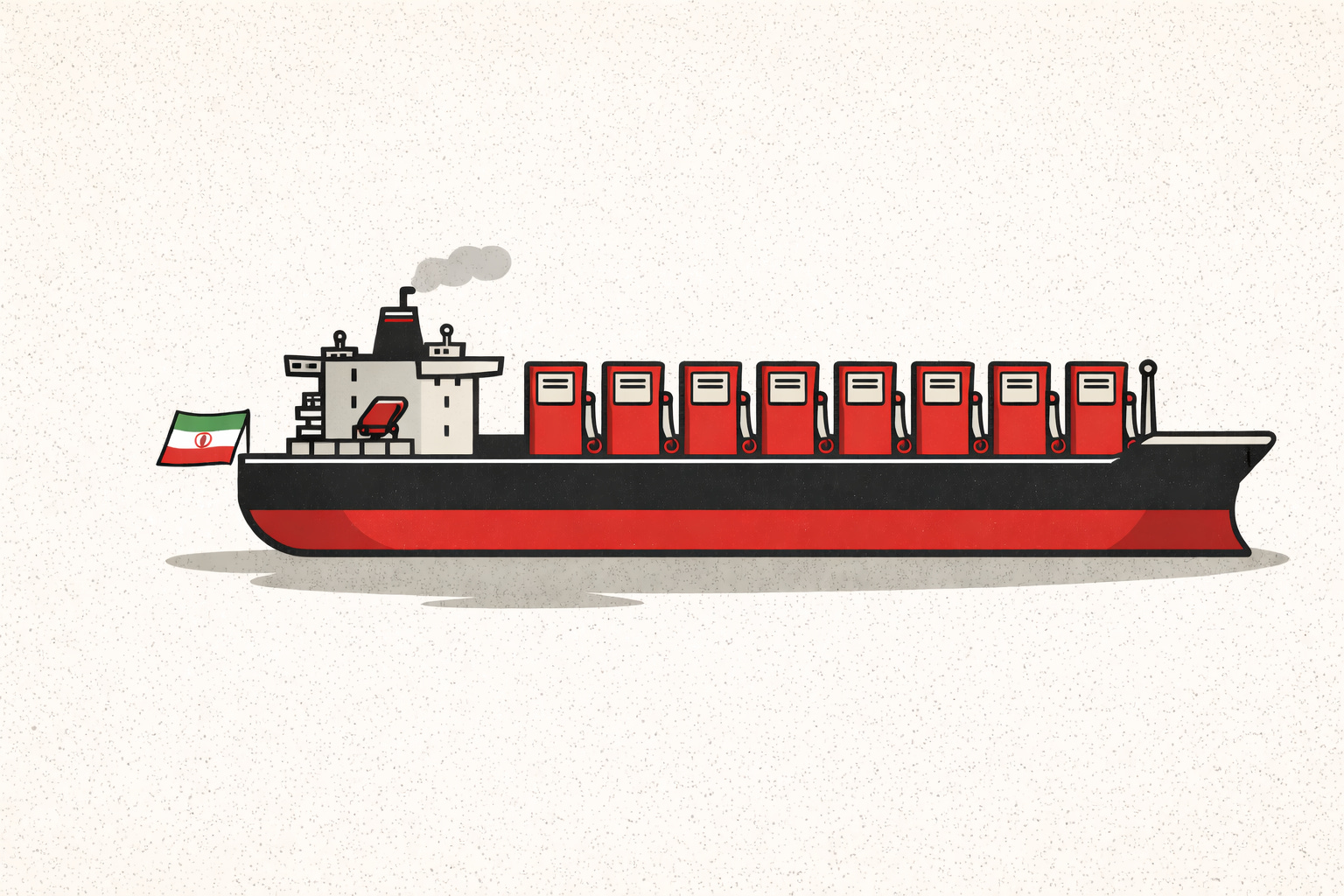
On March 20, the Trump administration issued Iran General License U (GL U), a one-month authorization for the purchase and sale of approximately 140 million barrels of sanctioned Iranian crude currently at sea. As a result, tens of millions of barrels of Iranian crude that had been sitting in floating storage appear to be re-entering global markets. Tankers that had effectively been parked are now moving, with buyers (primarily in Asia) stepping back in under a cloud of plausible deniability. This is not a policy overhaul, but rather a narrowly scoped attempt to manage a major market disruption.
Why we care: This is a significant deviation from the Maximum Pressure approach that has defined both Trump administrations’ Iran policy, and one that sits uncomfortably alongside a highly aggressive sanctions regime that otherwise remains fully intact. U.S. Treasury Secretary Scott Bessent framed the move as geopolitical “jiu-jitsu,” arguing that using Iranian oil to suppress global prices costs Tehran more than it earns. However, given GL U contains few provisions that would meaningfully limit Tehran from accessing revenues, Iran is likely to benefit from these sales by gaining revenue it can use to fund the war effort and its proxies across the region. This is a market-based intervention driven by domestic U.S. energy price concerns, not a negotiated concession from Tehran — with real risk the regime reads it as confirmation that its strategy of economic blackmail is working.
One Major Policy Shift: The Gulf is taking a harder line on how the war must end
Saudi Arabia, the UAE, and others, are quietly pressing Washington to ensure that any resolution includes durable constraints on Iran’s missile, drone, and proxy capabilities, not just a ceasefire. There is a growing insistence that the outcome must fundamentally reshape—not restore—the regional balance of power.
Why we care: After the 12-day U.S.-Israel war with Iran in June 2025, the Gulf states criticized Israel’s attacks and called for de-escalation. But now, after more than three weeks of Iranian retaliatory attacks on Saudi Arabia, Qatar, UAE, and other states, these nations have markedly shifted their approach from attempting to prevent conflict with Iran to insisting the conflict continue until the regime has been severely degraded, even though this was not a war of their choosing. Fairly recently, Riyadh and Abu Dhabi were pursuing a fundamentally different strategy. Saudi Arabia reestablished diplomatic relations with Iran in March 2023 in a Chinese-brokered deal, while the UAE had been quietly rebuilding economic ties with Tehran since 2019, both countries betting that direct engagement was a more effective hedge against Iranian destabilization than confrontation.
That calculus has now been overtaken by events. In the weeks since the war began, the shift in Gulf capitals has been visible and striking: Saudi Crown Prince Muhammad bin Salman reportedly said in a series of calls that the campaign presents a “historic opportunity” to remake the region and that Iran poses a long-term threat that can only be eliminated by removing the current government, according to the New York Times. The UAE’s Ambassador to the U.S. Yousef al-Otaiba made this sentiment explicit in a Wall Street Journal op-ed: “A simple ceasefire isn’t enough. We need a conclusive outcome that addresses Iran’s full range of threats: nuclear capabilities, missiles, drones, terror proxies and blockades of international sea lanes.” The endgame both Riyadh and Abu Dhabi are now signaling is an Iran so badly degraded it cannot meaningfully threaten its neighbors, hold global energy supply hostage, or reconstitute the regional leverage it has spent decades building.
One Under the Radar Development: Pakistan steps in as U.S.-Iran intermediary of last resort
With traditional diplomatic channels between the U.S. and Iran unavailable (Oman has also been under attack), Pakistan has emerged as a key intermediary between Washington and Tehran. Islamabad is playing an important role in relaying proposals and maintaining contact at a moment when other actors are either overexposed or sidelined. Pakistan’s role has now formalized beyond bilateral messaging: on March 29, the foreign ministers of Pakistan, Saudi Arabia, Turkey, and Egypt convened in Islamabad in what Al Jazeera described as the first meeting in that four-country format, with the Pakistani Government announcing it would host direct U.S.-Iran talks “in coming days.” That diplomatic momentum culminated yesterday in Beijing, where Pakistani Foreign Minister Dar and Chinese Foreign Minister Wang Yi jointly issued a Five-Point Initiative calling for a ceasefire, protection of energy infrastructure, and restoration of Hormuz navigation — a framework that signals Islamabad is now coordinating explicitly with Beijing, not just serving as a U.S.-facing interlocutor.
Why we care: The gathering is not improvised. It is the product of weeks of quiet Pakistani diplomacy that has benefited from a markedly warmer bilateral relationship with Washington, with Trump hosting army chief Field Marshal Asim Munir twice and publicly saying Pakistan “knows Iran very well, better than most.” We also read this diplomatic opening in the context of Pakistan’s broader competition with India for strategic relevance in the Middle East: as New Delhi deepens its footprint in the region through IMEC and a series of free trade agreements, Islamabad’s emergence as the indispensable interlocutor in the region’s most consequential crisis since the U.S. invaded Iraq offers a countervailing source of influence that Islamabad will be keen to convert into durable relationships across the Gulf.
Pakistan isn’t brokering a grand bargain, but it is keeping the system from seizing up. Although some observers doubt Pakistan’s ability to deliver results or that Iran is even participating in this channel, it is still noteworthy. In a fragmented diplomatic landscape, outer-tier players can become indispensable simply by being available, connected, and credible to both sides. Islamabad is trying to quietly remind Washington that it has geopolitical utility beyond South Asia.
One Source of Friction: South Pars drags shared energy infrastructure into the conflict
The March 18 strikes on South Pars—the world’s largest natural gas field, shared by Iran and Qatar—have expanded the conflict’s scope. The targeting of such a critical site raises the risk of spillover into other shared gas assets, as well as broader Gulf energy infrastructure.
Why we care: This is escalation by entanglement. South Pars isn’t just Iranian; it’s part of a shared reservoir system, meaning any sustained disruption has cross-border consequences. That creates a new kind of friction: one where third parties are pulled in not by choice, but by geology. The more interconnected the infrastructure, the harder it becomes to contain the conflict.
The retaliatory Iranian strike on Qatar’s Ras Laffan has taken offline approximately 17% of Qatar’s LNG export capacity — roughly 12.8 million tonnes per year — with cascading consequences for Europe and Asia that were already heavily exposed to Qatari supply following Russia’s exit from European gas markets. As Rystad Energy has documented, the repair timeline is the more alarming variable: the large-frame gas turbines needed to restore damaged LNG trains are supplied by only three manufacturers globally, all of which entered 2026 carrying production backlogs of two to four years, meaning Ras Laffan could remain meaningfully impaired long after any ceasefire is signed.
One Fun Thing: Rebuilding Palmyra—on canvas
At the Venice Biennale, one of the most prestigious art fairs in the world, Syrian artist Sara Shamma has rebuilt the ancient city of Palmyra through a series of large-scale works, reimagining the ancient city. During the war, ISIS desecrated the ancient city, causing severe damage to ancient Roman-era structures and used the theater for public executions. The project blends memory, loss, and restoration.
Why we care: In a region where physical infrastructure is once again under threat, cultural reconstruction offers a different timeline measured in decades, not news cycles. It’s a reminder that while geopolitics can focus on what’s being destroyed, there’s a parallel effort to define what is remembered and rebuilt. Almost 2,000 years ago, Palmyra was a critical node in the ancient Silk Road linking East and West, and evolved into an economic powerhouse and cultural hub. In today’s Syria, emerging from years of war and destruction, Palmyra also offers a vision of what the country could be again.