

Why Riyalpolitik?
Several years ago, the two of us met and quickly bonded over our shared obsession with the Middle East — a region where history moves dizzyingly fast and often sideways. We live around the corner from each other and would meet for walks around the neighborhood with our dogs to trade takes on the day’s events in Jerusalem, Gaza, Tehran, and Beirut, and occasionally debate where to find the most authentic hommous. From the launch of transformational national plans like Saudi Arabia’s Vision 2030, to the shock of October 7th and subsequent regional convulsions, to the once-unthinkable promise of integration through the Abraham Accords and the precipitous collapse of the Assad regime — we are witnessing seismic change. What started as a casual conversation turned into an ongoing dialogue and an interest to go deeper.
Professionally, we’ve spent years working in and on the region. One of us from the world of intelligence, national security, and sanctions; the other from the world of trade, investment, and business. Both of us have worked in government and understand how economic tools — both carrots (e.g. FDI, market access, and deals) and sticks (e.g. sanctions, tariffs, export controls) are used, where they’ve worked, and where they have fallen short. Our perspectives often diverged — not surprisingly, the view from inside a SCIF looks quite different than the view from the corridors of an American company. But we always found value by putting those competing, and occasionally conflicting, perspectives in dialogue.
What interested both of us — and what animates this project — is our sense that the economic stories beneath the headlines of the Middle East are too often overlooked or misunderstood. The region is still in the thick of war, but that turbulence is simultaneously accelerating strategic and economic shifts that will have lasting impacts on the region. Capital is moving in and out. Technologies are being developed and deployed. New partnerships are forming across borders and sectors. And governments, both in the region and beyond, are putting their fingers on the scale. And yet, conflict persists, humanitarian needs are growing, and the need for reconstruction is massive, with no clear roadmap in sight.
Despite this uncertainty and churn, it’s clear that the region is being shaped not only through peace deals and summits, but also through capital allocation and strategic investment. We’re fascinated by the people, politics, and power plays shaping decisions in the region.
Here’s what we’re watching and the types of questions we have:
Regional Investment: What can we learn about the influence and strategy of Gulf sovereign wealth funds and cross-border investment in sectors like energy, infrastructure, logistics, tech, and food security?
Reconstruction: Is there meaningful regional and multilateral action and opportunity on reconstruction in the region, particularly in Gaza, Lebanon and Syria?
Supply Chains and Economic Corridors: How are countries in the region positioning themselves – and the region as a whole – amid global economic change and intensifying great power competition?
Normalization: Are there signs of expanding the Abraham Accords and deepening economic ties between Israel and the region (and beyond)?
Innovation Ecosystems: How are regional tech hubs emerging—and what roles are governments, corporates, and venture capital playing in building platforms for AI, fintech, climate tech, and defense innovation?
Economic Statecraft: How are tools like sanctions, incentives, export controls, and investment agreements being leveraged by the U.S., Gulf states, and multilateral institutions to shape outcomes across the region?
We’re doing this because we are endlessly curious about the region’s transformations, and eager to capture our ongoing conversations about the economic forces reverberating throughout the region, and, believe it or not, are eternally optimistic that better days lie ahead. And by the way: there is also good news in the Middle East! Yes, that’s a thing.
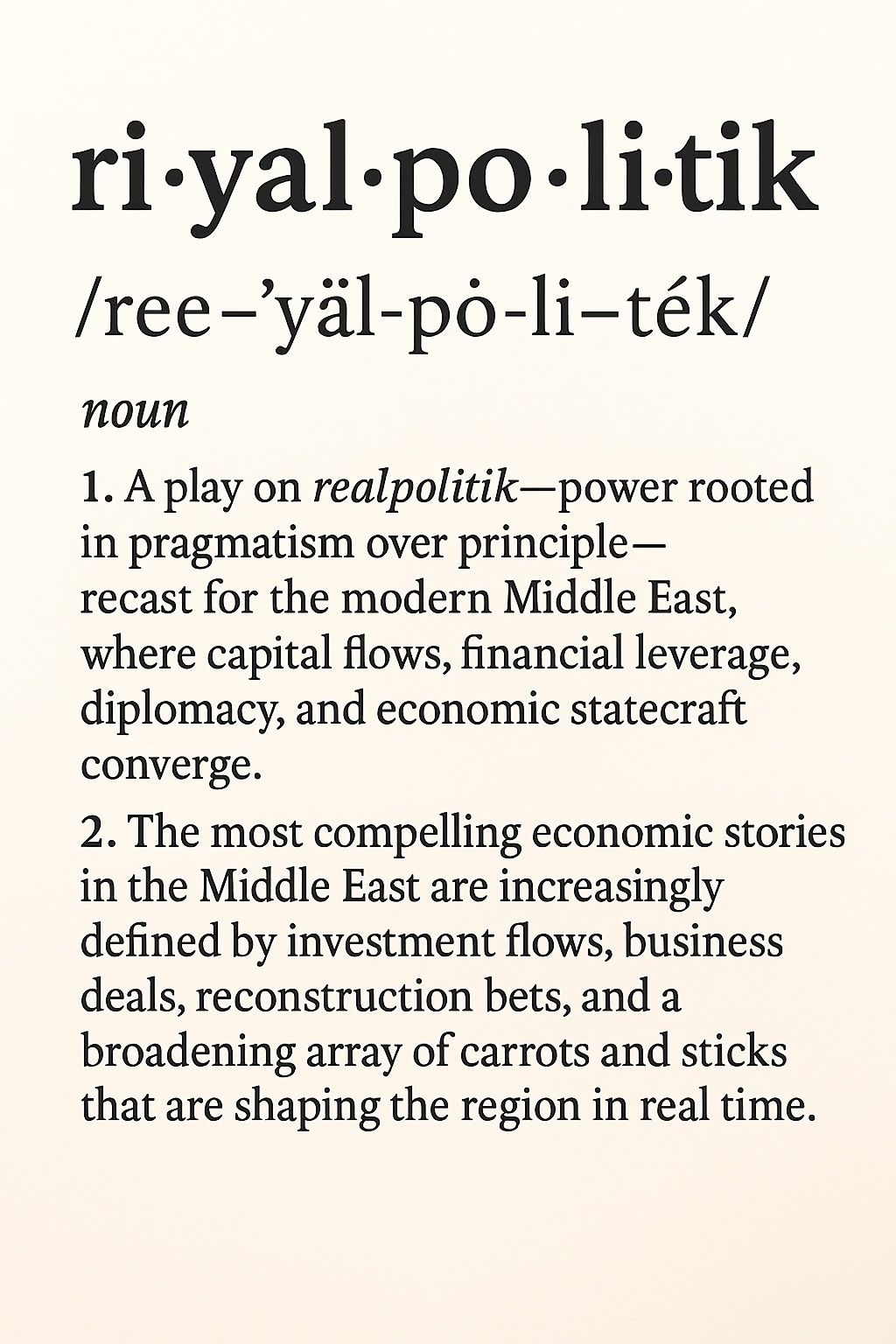
We didn’t invent the term “Riyalpolitik,” which has been used in journals and articles to refer specifically to Saudi Arabia’s use of its financial strength (i.e., Saudi Arabian Riyals) to advance the Kingdom’s political interests around the world. But we’re applying the term to something broader happening in the economic sphere across the region.
Riyalpolitik is our attempt to make sense of all of this — to explore the emerging economic narratives beneath the surface, where power, money, and ambition are converging to shape the region’s future. We’re tuning in to the economic stories that often get lost and that will lay the foundation for what comes next in this complicated, strategic, and fascinating part of the world.