

RP5: The US, Greece, Cyprus, and Israel establish the Eastern Mediterranean Energy Center (EMEC)
The Riyalpolitik 5 highlights five recent geo-economic developments across the Middle East that we’re keeping an eye on.
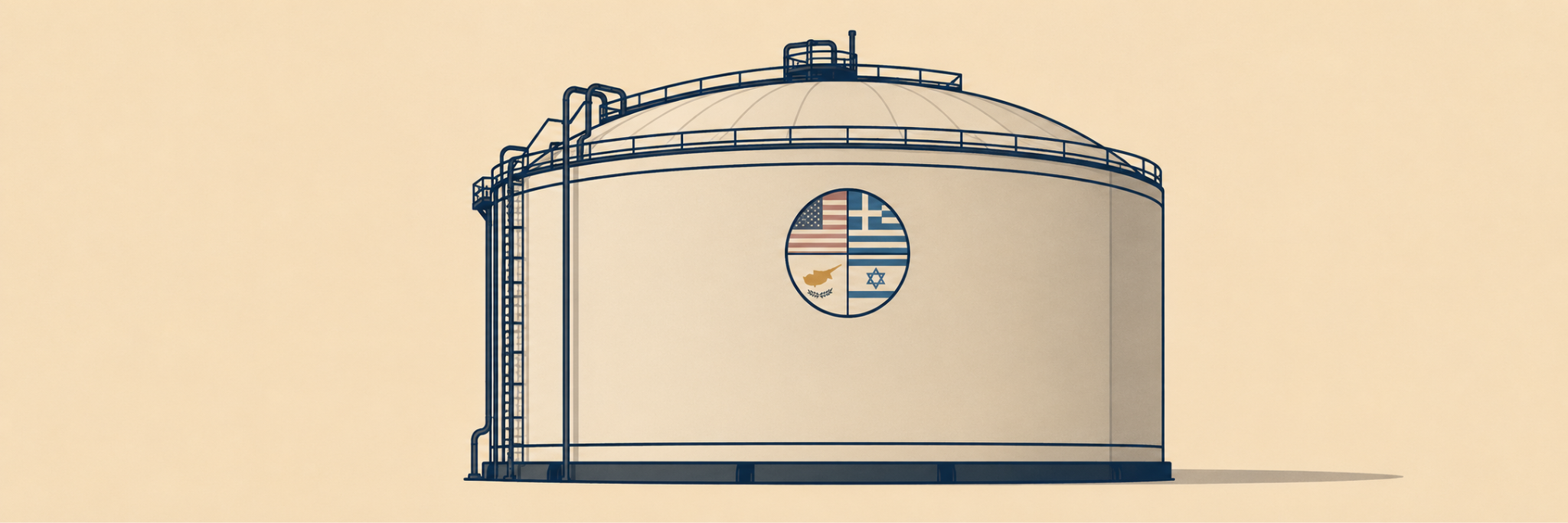
One Big Deal: The US, Greece, Cyprus, and Israel establish the Eastern Mediterranean Energy Center (EMEC)
Why we care: Housed at Rice University’s Baker Institute for Public Policy in Houston, the Center is intended to be a permanent platform for cooperation and research on natural gas development, critical infrastructure protection, cybersecurity, and regional energy connectivity. The Center adds another institutional framework to promote the Eastern Mediterranean as an integrated energy hub and geopolitical bloc. The announcement also came just days after a ministerial meeting of the Eastern Mediterranean Gas Forum (EMGF), the international organization established in 2019 to promote regional energy cooperation and develop an integrated Eastern Mediterranean natural gas market. The EMGF, which brings together Greece, Cyprus, Egypt, Israel, Jordan, France, Italy, the Palestinian Authority, and the United States, has remarkably weathered the conflict and overlapping crises in the region.
Last week, the Senate Foreign Relations Committee also advanced the Eastern Mediterranean Gateway Act, legislation that would elevate the Eastern Mediterranean as a U.S. strategic priority and deepen U.S. cooperation on energy, infrastructure, and regional connectivity. The elephant not in the room in these dialogues is Türkiye… and not by accident. Ankara was conspicuously excluded and considers these frameworks attempts to diminish its role as a regional energy hub, with Turkish’s president Erdogan claiming an expansion of its maritime sovereignty in the Eastern Mediterranean. Türkiye, for its part, seems to be hedging all around. It still imports a third of its natural gas from Russia, is working with Saudi Arabia and other regional partners on defense and rebuilding the Hejaz corridor linking Türkiye to the Gulf through the Levant, and is building out the western node of the Middle Corridor linking Europe to China, not to mention its role as a key NATO ally and U.S. partner. The EMEC is less about natural gas than it is a declaration of political alliances competing for the economic future of the region.
One Policy Development: US-Iran MOU gets quick reality check
Why we care: The 14-point Memorandum of Understanding (MOU) between the U.S. and Iran provides the first roadmap for how the two sides see ending the conflict that began in February. The MOU seems designed to build confidence through a series of early economic steps while the harder political issues are negotiated over the next 60 days. The big-ticket issues—Iran’s nuclear program, the U.S. providing systemic sanctions relief, and supporting a $300b fund to help rehabilitate Iran’s economy—are contingent on negotiations among two parties with zero trust in each other. The immediate deliverables are more concrete: reopening the Strait of Hormuz in return for easing restrictions on Iranian oil exports. The Treasury Department moved quickly on that front. On Monday, OFAC issued General License X, authorizing the production, delivery, and sale of Iranian crude oil through August 21, the most significant easing of Iran oil sanctions since 1979, and thus far the economic centerpiece of the framework deal. GL X also, for the first time, permits imports of Iranian crude into the United States. It is a striking concession from an administration that has previously made Maximum Pressure its battle cry, and one that gives Tehran a tangible early win while the thornier issues remain unresolved.
The MOU is already facing headwinds. Israel was not a party to the MOU, despite provisions calling for an end to hostilities in Lebanon. Since the agreement was signed days ago, fighting between Israel and Hezbollah has continued and the status of commercial shipping through the Strait of Hormuz remains in question. Markets have preliminarily responded positively to the MOU so far, but whether that optimism lasts will depend on whether ships and oil can move safely through the Strait and whether the parties can demonstrate tangible progress on the agreement’s much more intractable technical and political issues. We continue to watch these issues closely for signals of whether a so-called “grand bargain” between the U.S. and Iran may be in the making or whether this is simply the latest chapter in the 47-year conflict between the U.S. and Iran.
Under the Radar: Saudi Arabia opens its market to Lebanese exports after 5-year closure
Saudi Arabia first banned imports of all fruits and vegetables from Lebanon in 2021 after frustrations boiled over that Beirut wasn’t doing enough to crack down on drugs being smuggled into the Kingdom via Lebanese shipments. The relationship had in fact been deteriorating for years, most visibly in 2017, when then-Prime Minister Saad Hariri dramatically resigned in a televised address from Riyadh in what many Lebanese and international observers interpreted as a forced resignation, an episode that left scars on Lebanon-Saudi relations and underscored Riyadh’s willingness to intervene directly in Lebanese politics. Tensions worsened further in 2021 when a prominent Lebanese minister publicly criticized Saudi Arabia’s campaign against the Houthis in Yemen, prompting Riyadh to recall its ambassador, ban all Lebanese imports, and downgrade diplomatic ties.
This dealt another blow to Lebanon’s cratered economy, which had all but collapsed in the 2019 financial crisis. Before the ban, Lebanese fruit and vegetable exports to the Kingdom were estimated at around $24 million annually. The shift in Saudi policy now signals a meaningful step toward warming relations, and support for Lebanon’s new leadership and its efforts to reassert state authority and revive the economy. While Riyadh has not resumed the kind of direct financial support it once provided — including a multi-billion dollar commitment to arm the Lebanese Armed Forces that was ultimately suspended in 2016 — or announced reconstruction commitments akin to the billions pledged to Syria, reviving this trade relationship will help rebuild confidence and could ultimately be a stepping stone to broader Saudi investment in Lebanon’s longer-term recovery.
One Source of Friction: Lebanon Is the War’s Most Reliable Spoiler
Why we care: Despite the US-Iran MOU being signed this week (and an ephemeral renewed Israel-Hezbollah ceasefire brokered just days ago) renewed fighting between Israel and Hezbollah in southern Lebanon killed dozens after the ceasefire took effect, Iran closed the Strait of Hormuz again citing Israeli violations, and US-Iran follow-up talks in Switzerland were very nearly called off before Pakistan and Qatar scrambled to hold them together.
Lebanon was supposed to be the sideshow, not the main event. Article 1 of the MOU explicitly states that ending the war in Lebanon is an integral part of the broader ceasefire, which means every Israeli airstrike on Nabatieh and every Hezbollah rocket on an IDF position in the south is technically a violation of the framework Washington spent months constructing. Iran has been explicit about the importance of Lebanon to it. Netanyahu has been equally explicit in the other direction, telling his cabinet that the ceasefire does not apply to Lebanon, ordering the IDF to hold its positions there, and recently stating the IDF has full freedom of maneuver. Hezbollah was not a party to the Lebanon-Israel deal negotiated in Washington. The group rejected the negotiations outright, calling them “absurd, humiliating and insulting” — and demanded full Israeli withdrawal from southern Lebanon as a precondition for any halt in fighting.
The structural problem is that Washington does not talk directly to Hezbollah, while Israel does not consider itself bound by the US-Iran framework. That leaves a combustible gap between what the MOU requires, what Israel is prepared to do, and what Hezbollah will accept, with Lebanon’s civilian population absorbing the consequences of each miscalculation. The frustration inside the White House has become difficult to conceal: beyond the stern words offered by Vice President JD Vance, senior US officials have also been pointedly conducting back-channel outreach to Israeli opposition figures and alternate ministers, a signal that Washington is quietly gaming out what Israeli decision-making looks like in a post-Netanyahu configuration and whether a different government might prove a more willing partner on this front. In spite of potential progress being made in the US-Iran talks in Burgenstock, Switzerland, with Pakistan and Qatar as mediators, the fragile process is one bad night in southern Lebanon away from collapsing entirely. In the eyes of many, the war did not end this week. It paused, conditionally, with one of its most intractable fronts still unresolved.
One Fun Thing: Picasso in the Desert, Zayed on Saadiyat — the Gulf’s Cultural Bet Is Still On
Why we care: Two of the region’s most anticipated cultural institutions opened this month: Saudi Arabia’s AlUla Contemporary Art Museum with a Centre Pompidou co-curated exhibition featuring Picasso, Kandinsky, and Etel Adnan, and Abu Dhabi’s Zayed National Museum on Saadiyat Island, completing a trio of major institutions in Abu Dhabi alongside the Louvre Abu Dhabi and the newly opened Natural History Museum.
A Pompidou co-curated exhibition in a museum that didn’t have a name until this year, and a national museum opening on schedule in a country that absorbed more Iranian drone strikes than any of its neighbors this spring are quiet but deliberate acts of institutional continuity in the middle of a crisis. Both the AlUla and Saadiyat Island projects helpanswer to the same long-term question: what does a post-oil identity look like, and who gets to curate it? The Gulf’s cultural ambitions have always addressed an audience larger than the immediate region. They speak to global travelers, investors, and institutions who understand why the Gulf is worth coming back to. The bet is not just cultural. It is economic and reputational: tourism’s direct contribution to Saudi GDP has already grown from 3% at Vision 2030’s launch to roughly 10% today, with the World Travel and Tourism Council reporting Saudi tourism GDP at approximately $178 billion in 2025, making the Kingdom the Middle East’s single largest tourism economy. It is a transformation in which cultural destinations like AlUla and Saadiyat are load-bearing pillars, not decorative ones.
World Cup Addendum: The group stage is well underway and the results for MENA teams so far have been mixed.
🇲🇦 Morocco drew 1-1 with Brazil in one of the tournament’s marquee opening matches, then beat Scotland 1-0 to move to the top of Group C. The Atlas Lions are looking every bit the semifinalists they were in 2022, and are the region’s strongest early story.
🇮🇷 Iran are the tournament’s quiet overachievers so far: 2-2 with New Zealand in their opener, then a resolute 0-0 against Belgium in which goalkeeper Alireza Beiranvand made seven saves and Iran actually led the group heading into the final matchday. Friday’s upcoming Iran-Egypt clash in Seattle has a great deal of promise.
🇪🇬 Egypt recovered from an opening 1-1 draw with Belgium to beat New Zealand 3-1 in convincing fashion with former Liverpool F.C. superstar Mohamed Salah scoring a crucial second-half goal, putting Egypt in pole position in Group G going into the Iran match-up.
🇸🇦 Saudi Arabia drew 1-1 with Uruguay on matchday one, then were hammered 4-0 by Spain on Sunday. The Green Falcons need a win against Cape Verde on Friday to have any chance of advancing — a group stage exit would be disappointing for the country hosting the 2034 tournament.
🇮🇶 Iraq lost 4-1 to Norway in their opener and lost to France 3-0 on Monday. Their return to the World Cup after a 40-year absence has been a rough reintroduction to the game’s highest level.
🇩🇿 Algeria came from behind to beat Jordan 2-1 at Levi’s Stadium in Santa Clara, with goals from Nadhir Benbouali and Amine Gouiri overturning a first-half deficit. The result keeps Algeria’s hopes alive; they now face Austria in a winner-takes-all Group J decider.
🇯🇴 Jordan — making its World Cup debut — was eliminated after two games, losing 3-1 to Austria and then 2-1 to Algeria.
🇹🇷 Türkiye ended its 24-year World Cup absence, but it has not gone well: lost 2-0 to Australia, then 0-1 to Paraguay, and now face a must-win against the United States in Los Angeles on Friday.