

RP5: The Gulf Is Building Its Own Arsenal
The Riyalpolitik 5 highlights five recent geo-economic developments across the Middle East that we’re keeping an eye on.
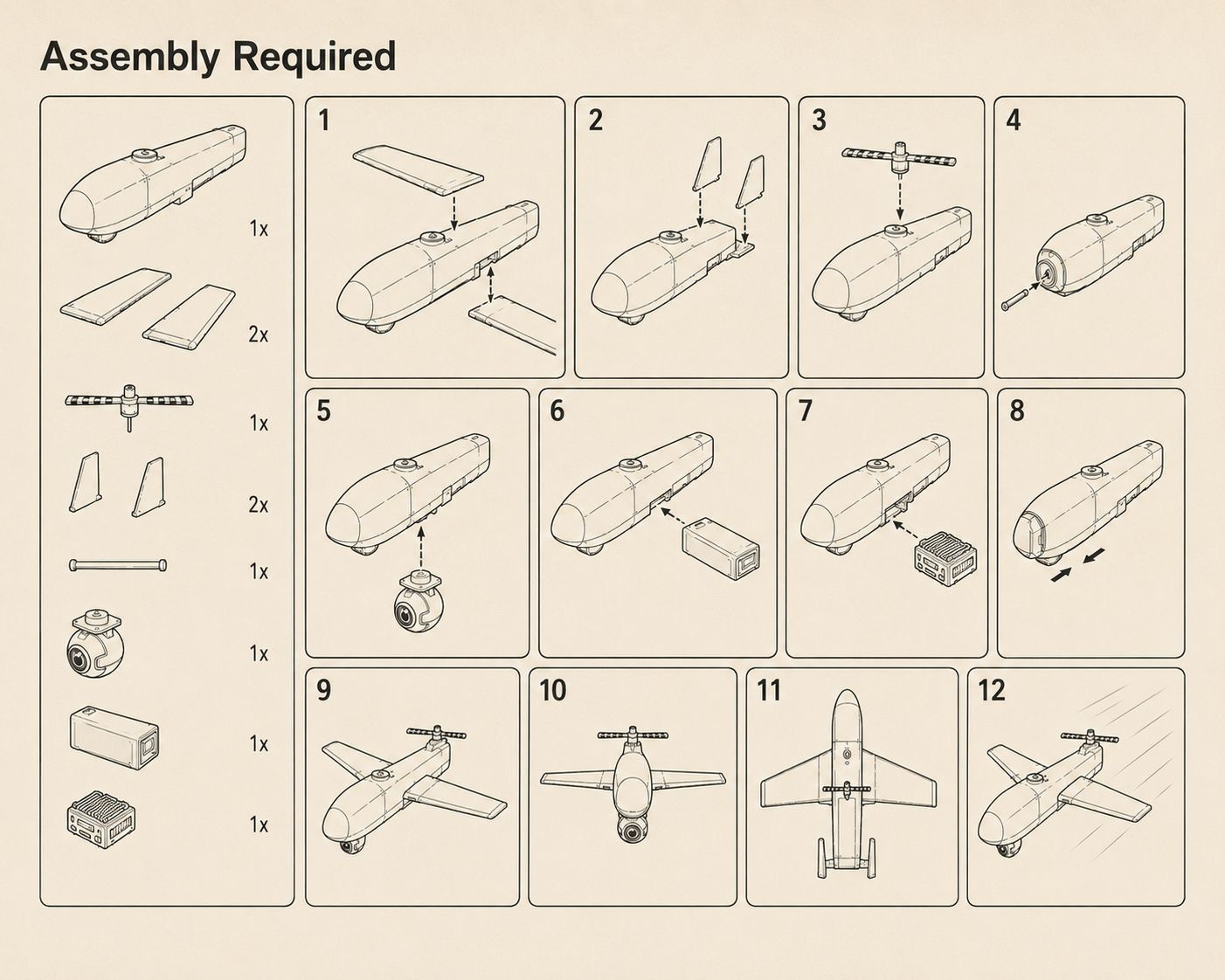
One Big Deal: The Gulf Is Building Its Own Arsenal
Two developments this month signal that the Gulf’s approach to security is fundamentally shifting from investing in defense to manufacturing it at home.
Why we care: As the crisis in the Strait of Hormuz continues, Gulf states are increasingly taking security into their own hands. A US-Saudi joint venture is building a factory near Riyadh to produce SKYWASP, a combat drone modeled on Iran’s own Shahed system and capable of hitting targets up to 1,500 kilometers away, roughly the distance from Saudi Arabia’s northeast coast to Tehran. Simultaneously, Bloomberg reported that Abu Dhabi is in preliminary talks to create a new defense-focused investment vehicle — separate from its existing sovereign wealth funds — mandated to take stakes in defense firms worldwide, from established European and U.S. manufacturers to Ukrainian and Turkish drone makers.
The logic behind both moves is the same. Iran fired thousands of Shahed drones at Gulf targets over the past three months, each costing roughly $35,000 to produce but requiring interceptors that cost multiples of that to shoot down. This asymmetry challenged Gulf air defenses and is now driving the region’s most consequential defense industrial build-up in a generation. Saudi Arabia imports almost all of its military equipment and has set a goal of localizing 50% of defense spending by 2030; the SKYWASP factory is the clearest sign yet that this is no longer an aspiration but an active program. The UAE’s contemplated defense fund follows the same logic at the investment level: Abu Dhabi controls nearly $2 trillion in sovereign wealth and is now considering deploying a dedicated slice of it into the global defense sector, just as European rearmament and Gulf demand are driving valuations sharply higher. The war did not create these ambitions, but it has underscored the urgency for self-reliant self-defense.
One Policy Development: Trump Tries to Tie Iran Deal to the Abraham Accords…and Gets Crickets
In an out-of-left-field-gambit to reshape the region while negotiating with Iran, President Trump “mandatorily requested“ that countries across the Middle East join the Abraham Accords. Ceasefire negotiations with Iran remain pending, the Strait of Hormuz remains effectively closed, and the negotiations remain unresolved.
Why we care: Last week, Trump raised the stakes considerably by linking any Iran peace framework to a demand that Saudi Arabia, Qatar, Pakistan, Turkey, Egypt, the UAE, Jordan, and Bahrain simultaneously join the Abraham Accords and normalize relations with Israel (five of these countries already have diplomatic relations with Israel). When Trump made the pitch on a group call with regional leaders, an uncomfortable silence followed, prompting him to ask if anyone was still on the line (Bueller? Bueller?). The answer, in diplomatic parlance, was “F*** no:” Saudi Arabia reaffirmed that normalization with Israel was impossible without an irreversible pathway to Palestinian statehood, Pakistan called the demand politically toxic, and Qatar flatly rejected it.
The Abraham Accords gambit is doing two things simultaneously, and only one of them is diplomacy. Trump needs to show the hawkish, maximalist wing of his own party, which views any agreement short of Iranian capitulation as appeasement, that he extracted maximum concessions in exchange for ending the war. Tying normalization to the ceasefire is the domestic political cover.
Needless to say, the Middle East in 2026 is fundamentally different than it was in 2020 (Wait - what?) when the original accords were signed: Israel is conducting ongoing strikes in Gaza and Lebanon, Gulf states have absorbed direct Iranian attacks on their territory, and Saudi Arabia’s Mohammed bin-Salman has reportedly cooled significantly on normalization since his November White House meeting. The demand, viewed in most regional capitals as preposterous, may ultimately be walked back, but added yet another layer of complexity to negotiations that were already far from resolution.
One Source of Friction: Oman in Trump’s Crosshairs
This week, President Trump threatened to “blow up” Oman after reports that Muscat and Tehran were discussing a mechanism to manage transit through the Strait of Hormuz, including a potential toll. Oman has publicly denied the reports.
Why we care: Oman is often one of the Gulf’s least discussed countries (except when people are talking about its beautiful beaches), but has become one of the region’s diplomatic heavyweights. For decades, Muscat has served as a trusted interlocutor between parties that either can’t or won’t talk directly. The Sultanate helped broker the secret U.S.-Iran talks that led to the 2015 nuclear deal. It stayed out of the Saudi-led, GCC-backed war in Yemen, maintaining relationships with all sides, and more recently served as a go-between for Washington, Tehran, and the Houthis as attacks on commercial shipping in the Red Sea threatened to drag the region into a wider conflict.
Oman’s location is also becoming increasingly important. Unlike most Gulf states, it sits largely outside the Strait of Hormuz with direct access to the Arabian Sea. It has not escaped the conflict entirely. Iranian drone strikes reportedly hit targets in the country during the war, underscoring that neutrality does not guarantee immunity. The same could be said about this week’s tensions with the White House. For years, Oman’s ability to maintain relationships with all sides has been one of its greatest strategic assets, but the latest zero-sum bombast has some wondering whether it is also something of a liability.
Yet compared to its Gulf neighbors, Oman has emerged from the crisis in a stronger strategic and economic position than many expected. As companies rethink shipping routes, supply chains, and geopolitical risk, its geography is becoming a real advantage. Oman is increasingly positioning itself as an alternative logistics and trade hub linking the Gulf, India, and East Africa. That helps explain why India brought its Comprehensive Economic Partnership Agreement with Oman into force this week.
Under the Radar: The “Day After” in Gaza Remains Everyone’s Problem and Nobody’s Plan
While ceasefire negotiations dominate the headlines, the question of who actually governs Gaza after the war is being worked out in hotel rooms, intelligence meetings, and empty bank accounts. The picture is not encouraging.
Why we care: Three developments this week, read together, tell a concerning story. First, Shin Bet Director David Zini reportedly met in Abu Dhabi with Mohammed Dahlan, the exiled former Fatah security chief who has spent years as an adviser to the UAE’s Mohammed Bin Zayed and has repeatedly been floated as a US-Emirati-Israeli preferred candidate to govern post-war Gaza. Regional officials assess that the meeting confirms Dahlan remains a key player in the US-Emirati-Israeli axis on Gaza governance, despite his public insistence that he will not accept any executive role. Dahlan is a deeply controversial figure. He was sentenced in absentia by the Palestinian Authority on multiple corruption-related charges, is despised by Hamas, and has no democratic mandate. His possible emergence as a serious candidate reflects the absence of better options more than confidence in his prospects.
Second, the “Board of Peace,” the body created by Trump to coordinate Gaza’s reconstruction, has received zero dollars in its official World Bank-administered fund, despite member countries pledging billions. Donations have instead been quietly routed through a JPMorgan account with no independent transparency requirements. The Board’s own explanation — that there is nobody in Gaza to receive and spend reconstruction money — is both technically accurate and damning. Third, the FT reported that Israel still retains military control over roughly 70% of Gaza, including all entry and exit points, with the population concentrated on the coast. This makes reconstruction not just unfunded, but also physically impossible under current conditions. The governance vacuum, the missing money, and a growing military footprint are not three separate problems. They are interrelated, and none of the parties with influence over the outcome appears close to resolving it.
One Fun Thing: The Hajj Went Ahead Smoothly — and That Is Worth Noting
This year’s Hajj, which concluded last week, drew 1.7 million pilgrims to Mecca, a slight dip from the 1.8 million who attended in 2024, likely reflecting the regional disruption caused by the war.
Why we care: Saudi Arabia deployed its most comprehensive unified digital platform to date, consolidating travel, accommodation, and permit applications — including, notably, 30,000 pilgrims from Iran — in a logistical undertaking that required coordinating over 1.5 million international arrivals across air, land, and sea entry points while a war was ongoing in the region. The Hajj is simultaneously the Kingdom’s most ancient revenue stream and its most sacred logistical challenge. Average spending per pilgrim in 2026 is estimated at almost $9,000, with combined Hajj and ’Umrah revenues amounting to around $40 billion, equivalent to 4–7% of Saudi GDP, making the Hajj season a multi-billion dollar economic event that Saudi Arabia is actively trying to modernize and expand.
That it proceeded at all, with Iranian pilgrims attending a Saudi-hosted event in the middle of a war involving Iran attacking its Arab Gulf neighbors, is itself a kind of diplomatic feat that formal channels cannot easily replicate. In a year when the Kingdom’s international image has been defined by war and fiscal tightening, 1.7 million pilgrims arriving peacefully in Mecca is the kind of soft power that no press release can manufacture and not many other countries can easily achieve.