

RP5: Iran Threatens Hormuz Oil Tax
The Riyalpolitik 5 highlights five recent geo-economic developments across the Middle East that we’re keeping an eye on.
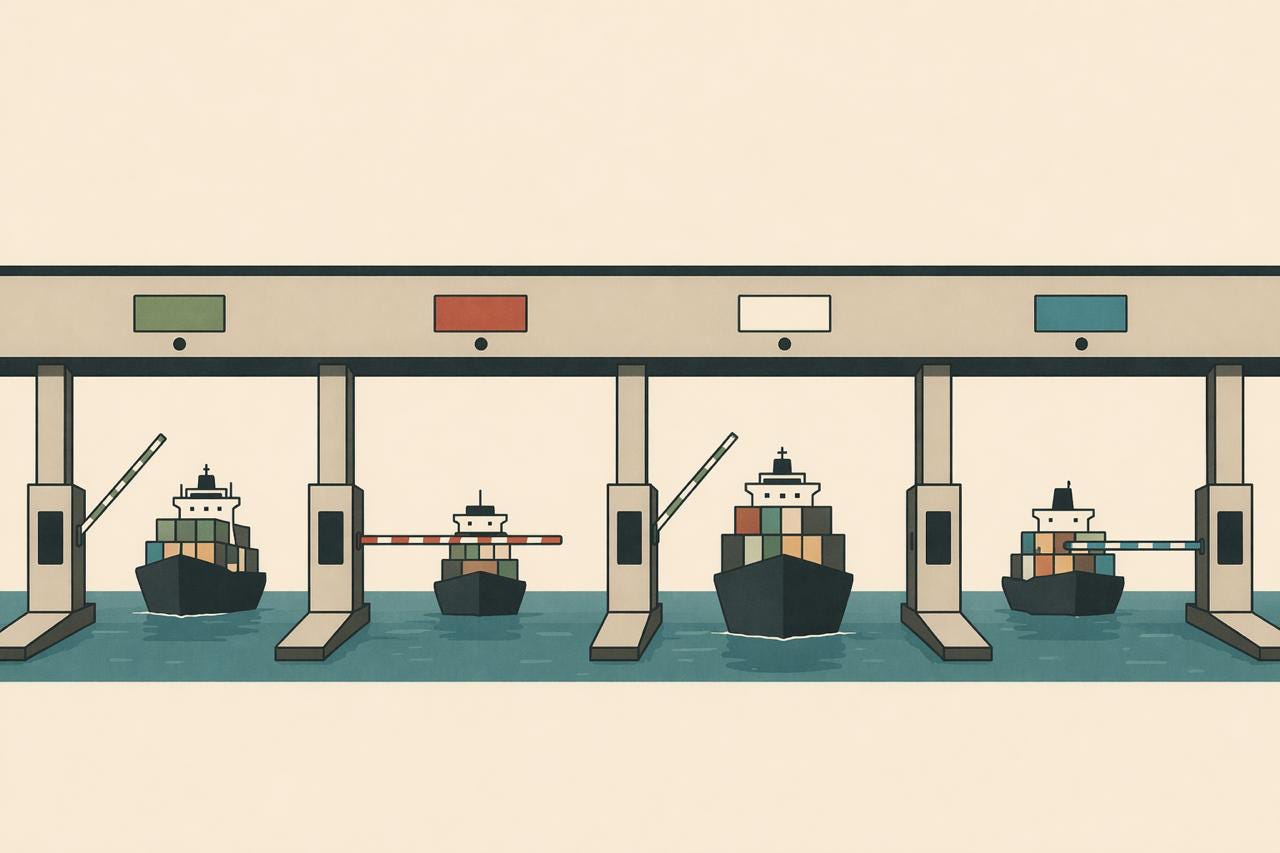
One Big Deal: Iran announced it would levy a $1 tariff on each barrel of oil transiting the Strait of Hormuz, to be denominated in crypto and yuan.
Why we care: This move simultaneously demonstrates Tehran’s appreciation for the economic leverage it has created for itself and seeks to insulate this revenue from the dollar-based financial system and long arm of the U.S. Treasury Department. The volumes of oil at stake are significant. According to Kpler data cited by the Financial Times, around 175 million barrels of crude and refined products are currently loaded on 187 tankers waiting in the Gulf. Even a fraction of this transit volume could provide a sorely needed source of liquidity, with the rial close to worthless and Iran’s economy in utter disarray. As the Wall Street Journal wrote, because oil is a globally priced commodity, Gulf producers can’t pass the toll cost on to buyers — they compete with oil from regions unaffected by the toll (like the U.S.), so they’d have to absorb it themselves, potentially up to 80-95% of the total toll burden.
Beyond the current crisis, the “Tehran tollbooth” in effect represents institutionalized piracy and sets a precedent for other actors to impose fees on trade in global chokepoints. In a rebuke to this ploy, however, as the U.S. navy began its blockade of the Strait of Hormuz on Monday, President Trump noted that he had sent instructions “to seek and interdict every vessel in International Waters that has paid a toll to Iran. No one who pays an illegal toll will have safe passage on the high seas.”
One Policy Shift: Israeli and Lebanese ambassadors to the US met to discuss peace negotiations.
Why we care: The talks, held under the auspices of the United States, are taking place against the backdrop of ongoing U.S.-Iran negotiations, where Tehran is pushing to fold Lebanon into the ceasefire by forcing Israel to halt military operations there, a condition both Israel and the U.S. have rejected. Meanwhile, on the ground, Israel has intensified strikes, and exchanges of fire with Hezbollah persist. Over the past 2.5 years of this latest round of conflict with Israel, Hezbollah’s capabilities have been degraded and its checkbook weakened as its primary backer in Tehran fights for its life, but the group still has meaningful capacity and continues to threaten Israel’s north.
The Israel-Hezbollah conflict dates back to the group’s formation during the Lebanese Civil War and has shifted between full-scale wars, skirmishes, and short-lived ceasefires. For Israel, anything short of pushing Hezbollah away from the border — or fundamentally changing the security equation — is increasingly unacceptable. The subtext in PM Benjamin Netanyahu’s remarks over the weekend was clear: this isn’t about another ceasefire – there have been plenty of those. Saying any deal must “last for generations” signals a shift away from managing the threat toward trying to end it altogether.
The U.S. role is also key here. Washington brokered the 2022 Israel–Lebanon maritime deal, proof that progress can be made. But this is far more complicated. The U.S. isn’t a neutral mediator — it is waging war on Iran, while Iran is actively trying to link Lebanon to negotiations to gain leverage. At the same time, the current government in Beirut is showing signs of a harder line against both Iran and Hezbollah and asserting more independence than it has in years, publicly criticizing Hezbollah for dragging the country into conflict and moving to expel Iran’s ambassador in late March.
One Source of Friction: Vice President JD Vance left Pakistan on Saturday evening without a deal, saying the Iranians “...have chosen not to accept our terms.”
Why we care: Iran didn’t show up to Pakistan just to extend a ceasefire, but rather to renegotiate broader terms of engagement. Reports of a large delegation suggest Tehran came with a full agenda: sanctions relief, access to frozen assets, constraints on U.S. and Israeli military activity, and even questions around control of the Strait of Hormuz. In other words, this wasn’t a de-escalation talk – it was an attempt by the Iranians to convert their economic leverage through the Strait of Hormuz into a wider strategic reset.
At the same time, the U.S. continues to ratchet up the pressure on Iran. A second carrier strike group is headed for the region, beefing up U.S. military forces to more than 50,000, a force posture not seen since the 2003 Iraq War, and a naval blockade on any ships heading to or from Iranian ports. Over the weekend, the cost of oil once again broke the $100/barrel threshold, up from $90s/barrel just after the cease fire agreement was announced, showing market uncertainty about the tenuous situation and growing risk of continued military operations even before the pause expires on April 21. Since the weekend’s talks, Pakistan, Türkiye, and Egypt have been working to keep the talks intact and prevent a breakdown between Tehran and Washington, and Trump has signaled that negotiations could resume within the next two days in Islamabad.
One Under the Radar: Ukraine signed defense deals with Saudi Arabia, Qatar, and the UAE
Why we care: Ukraine is trading the battle-hardened counter-drone expertise it has developed over the past three years of war with Russia for the Gulf’s vastly more expensive air defense systems and the fuel Ukraine desperately needs. These 10-year defense deals between Ukraine and several Gulf states underscore the changing needs from the battlefield in real time and how quickly innovation is moving from one theater to another.
Ukraine’s interceptor drones cost roughly $1,000–$3,000 per unit. The Gulf has been knocking down Iranian Shaheds with Patriot systems at nearly $4 million each. That price gap is the entire pitch — and it’s working. But the strategic subtext runs deeper: Ukraine is carving out a foothold in the Middle East as a security partner, giving the Gulf states a counterweight to Russia’s deepening ties with Iran, and positioning Kyiv as an indispensable player for scalable drone interception tech in a wealthy region facing pressing security concerns it had little presence in before this war. For Ukraine, these deals are as much about revenue and strategic relevance as they are about solidarity. Integrating Ukrainian technology could also make the Gulf bigger players in the region’s drone ecosystem, which is currently dominated by Israel and Türkiye.
One Fun Thing: A shelved Saudi drama about Iranian hostages is back, and the timing is everything.
Why we care: Filmed four years ago, then quietly buried after the 2023 Saudi-Iran détente, Embassy 87 is suddenly very relevant again.The revival of Embassy 87 isn’t just good television timing, it’s also a political signal. In the Gulf, big media doesn’t get rolled out by accident: MBC is largely government-owned, and green-lighting a drama about Iranian hostage-taking and the IRGC’s brutality sends a message that Riyadh is done managing perceptions of Tehran. The show can be viewed as a proxy for the broader Saudi mood shift — from the carefully choreographed détente of 2023 to a posture that now openly relitigates decades of Iranian aggression and destabilization. In the Middle East, as elsewhere, the stories that are broadcast can be as deliberate and have as much an impact as anything said at a podium.