

RP5: India and Oman Sign Major Economic Pact
The Riyalpolitik 5 highlights five recent geo-economic developments across the Middle East that we’re keeping an eye on.
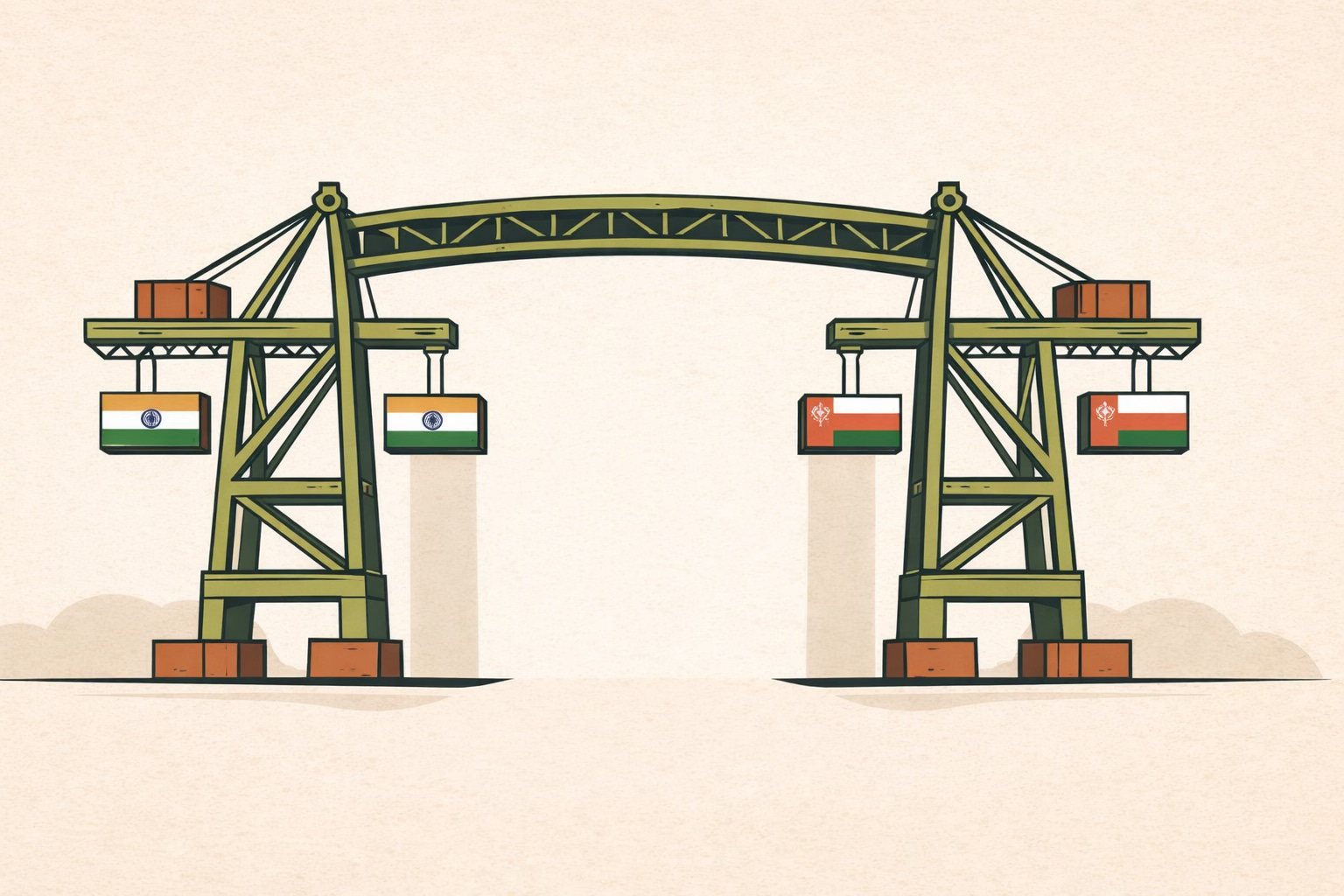
1 Big Deal: India and Oman Sign Major Economic Pact
India and Oman signed a Comprehensive Economic Partnership Agreement (CEPA) in mid-December, cutting tariffs on most goods and expanding cooperation on services, investment, and labor mobility.
Why we care: The deal reinforces India’s strategy of embedding itself more deeply in Gulf trade, logistics, and capital networks, following its 2022 CEPA with the UAE. Alongside major Emirati, Qatari, and Saudi investments in Indian ports, energy, and infrastructure—and India’s enthusiasm for IMEC—the agreement signals a deliberate knitting together of Indian and Gulf economic and strategic ambitions. With trade talks also underway with Bahrain and the GCC, the trajectory of India–Gulf integration is increasingly clear.
1 Major Policy Shift: U.S. Repeals Caesar Act
The U.S. Congress fully repealed the Caesar Syria Civilian Protection Act in mid-December as part of the FY2026 National Defense Authorization Act.
Why we care: The repeal comes as Syrian President Ahmed al-Sharaa has been increasingly embraced by the US and key regional powers, with Türkiye and several Gulf states already prioritizing early investments in Syria’s rehabilitation and reconstruction. The move dismantles one of the most restrictive sanctions regimes imposed since 2019, opening pathways for reconstruction financing, trade, and gradual reintegration into global markets. It also signals a shift in U.S. economic statecraft toward more targeted, risk-based tools, a change that has already prompted U.S. energy and financial services to explore engagement in Syria.
1 Under the Radar Development: Lebanon’s ‘Financial Gap’ Law Aims at Investor Reset
Lebanon’s cabinet advanced a draft “financial gap” law to allocate more than $70 billion in crisis-era losses across the state, central bank, commercial banks, and depositors.
Why we care: The legislation is a key precondition for unlocking IMF support and restoring confidence among Gulf and international investors after years of paralysis. It also represents a rare acknowledgment that the state and banking sector must also shoulder responsibility for systemic failure rather than placing the burden solely on depositors. Still, investor caution is likely to persist given Hezbollah’s efforts to reconstitute its military capabilities and uncertainty over the Lebanese government’s ability—or willingness—to fully disarm the group.
1 Source of Friction: Iranian Rial Dives and Protests Erupt
The Iranian rial has taken a nosedive and is at a historic low relative to the dollar with inflation over 40%, triggering street protests and renewed concern about stability.
Why we care: The Central Bank of Iran governor resigned and amid protests, Iranian officials are bracing for further instability. The economic shock coincides with louder threats of intervention from the White House, the leadership’s lingering PTSD from the 12-day war in July, and the weekend’s capture of former Venezuelan President Nicolás Maduro, raising questions about Washington’s threshold for kinetic action. For a comprehensively sanctioned regime like Iran, the rial’s slide and the sustained unrest point to a more consequential issue than inflation alone: whether the current political order can endure prolonged economic and social stress without fracturing.
1 Fun Thing: Syria Redesigns Its Banknotes
Syria unveiled new banknote designs that notably omit images of Assad family members, breaking with decades of the ancient regime’s iconography and cult of personality.
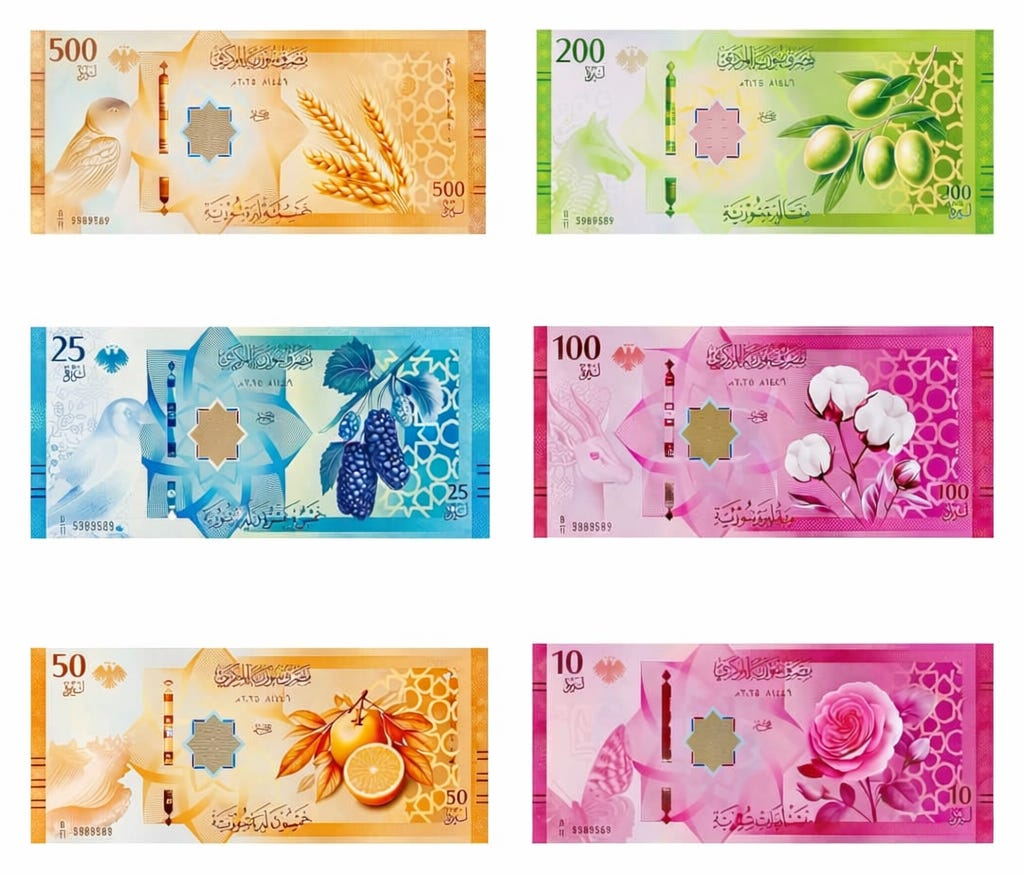
Why we care: While largely symbolic, the redesign hints at an effort—however modest—to rebrand state institutions as Syria cautiously tests reentry into regional and global economic circuits. Currency imagery reflects national identity and mythology, and the new banknotes, which include images of national symbols like roses, wheat, olives, and citrus fruits, suggests sensitivity to how Syria is perceived by foreign investors and partners. At minimum, it is a telling marker of how Damascus is adjusting its global image in a post-sanctions environment.