

The Middle East and the AI Olympiad
AI competition may be a two-way race but the region wants in.
By Josh Kram
This article in Bloomberg caught our attention, because it broke down this amorphous concept that seems to be inescapable in today’s tech and investment landscapes — that the U.S. and China are locked into a two-way race for AI supremacy, with grave consequences for the loser. The piece breaks this down like the Olympics of tech – scoring the U.S. and China on who leads in which part of the tech stack, including regulation, capital expenditure, talent, and infrastructure.
At the same time, the Middle East is playing an increasingly prominent role in the AI race. There is a dizzying amount of activity coming out of the region. Gulf countries, most notably Saudi Arabia and the UAE, are spending tens of billions of dollars to put AI at the core of their economic modernization plans – capex akin to what the magnificent seven are spending in their own AI arms race against each other. Massive AI infrastructure is being laid, AI campuses are being built, and large-scale partnerships between American tech giants are taking shape in the region. And across the Middle East, investment dollars are looking for winning innovation.
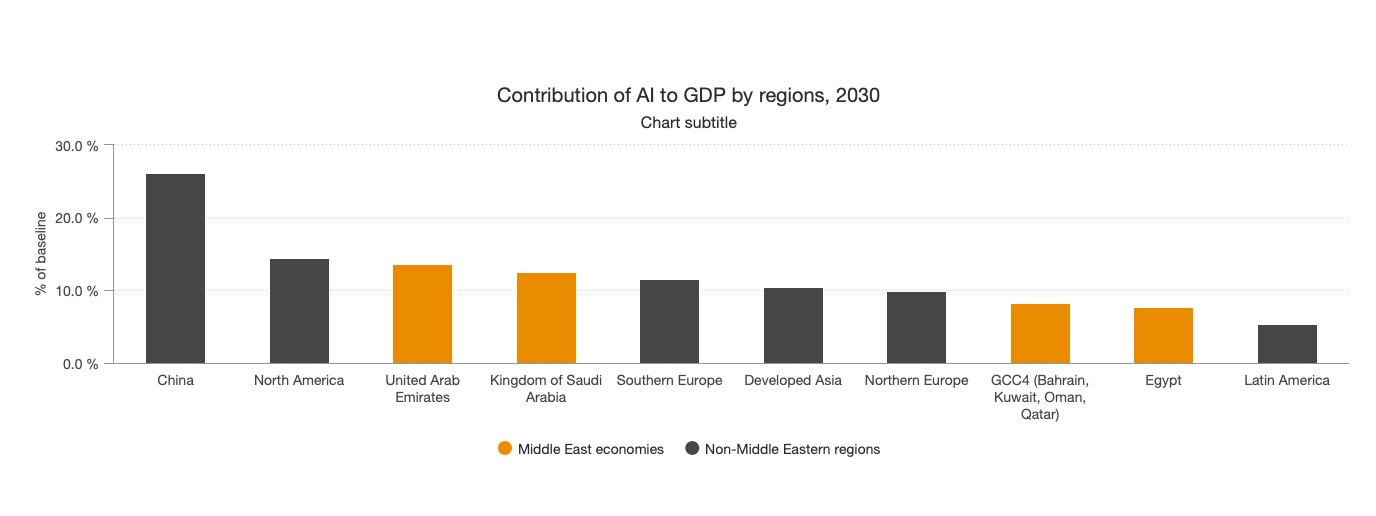
Why the focus? As countries like Saudi Arabia and the United Arab Emirates continue to diversify their economies away from oil and gas, they see great potential in AI driving GDP growth across industries and sectors. PWC believes that by 2030, AI could contribute nearly 14% and 12.4% of GDP to the UAE and Saudi Arabia, respectively. Those would be massive gains.
So it got us thinking: how does the Middle East stack up in the global “AI Olympiad?” And what will it take to compete on the world stage?
Here are the four I’s that we’re watching:
Intent
The UAE launched its National Strategy for AI in 2017 and along with it, the world’s first Minister of State for Artificial Intelligence. The strategy is guided by the vision to position the UAE as a global hub, integrate AI into government services and educational curricula, and invest in talent, R&D, and an AI-supportive ecosystem.
As part of Vision 2030 – Saudi Arabia’snational plan for economic diversification, the Kingdom has laid out an ambitious strategy for data and AI that includes skills development, creating the right policy environment, and investing in and attracting international capital to boost AI assets. Its official national plan seeks to make the Kingdom among the top fifteen countries in AI.
Other regional players, such as Qatar, Bahrain, Oman, Egypt, and Jordan, - have put national AI strategies in place that include regulatory frameworks, use of AI for public services, and institutional initiatives focused on talent development, but the scale of the ambition is more national; Saudi and the UAE are seeking to impact on a global scale.
Meanwhile, Israel has launched a series of national AI initiatives over the past few years. The most recent effort, led by a government-appointment advisory committee, created a national plan to accelerate the country’s focus on AI and specifies the need for Israel to catch up to other regional states, such as UAE and KSA. This includes development of super computing infrastructure, centralized government decision-making authority, and investment in human capital to position Israel “among the top five countries in the world in AI.” Israel is seeking to replicate its successful play ran ten years ago in the cybersecurity domain, which made it one of the main destinations for investment in cyber technology globally.
But good intentions will only get you so far…
Investment & Infrastructure
One of the biggest differentiators across the region is the amount of capital they have to plow into these ambitions. In Saudi Arabia and the UAE, massive capex commitments from their sovereign wealth funds set them apart. Not only in the region but as global players as well.
In the UAE, G42 is the sprawling AI conglomerate chaired by Sheikh Tahnoun bin Zayed aka TbZ, the country’s national security advisor and brother of the ruler. To call it a “company” understates its role. G42 is the embodiment of the Emirates’ ambition to become a global AI hub, building the infrastructure, applications, and investment channels to make it happen. Wired’s piece earlier this year on TbZ is a must-read on the personification of UAE’s strategic ambition in technology driven by its massive wealth and the bets it’s making in the “multiplayer game of strategy that is the AI arms race.”
G42 also launched MGX, a $100 billion investment fund, alongside Mubadala, to invest in and deploy advanced AI technologies and infrastructure. MGX has also joined forces to create a consortium with Blackrock and Microsoft to mobilize billions of dollars for investments in data centers and the energy to power them. Nvidia, xAI, the Kuwait Investment Authority, and Tamasek have joined the consortium as well.
In May, Saudi Arabia’s Public Investment Fund (PIF) launched Humain, the Kingdom’s flagship vehicle to drive investment in AI infrastructure, platforms, Arabic large language models (LLMs), and applications. Humain is set to become the Kingdom’s central hub for AI activity and is already moving quickly, securing access to hundreds of thousands of Nvidia’s most advanced chips and forging major partnerships with U.S. tech firms, such as NVIDIA, AWS, and Groq, to build out infrastructure in the Kingdom.
And not to miss the wave, the Qatar Investment Authority just announced a significant investment in Anthropic, among other smaller AI firms. Sara Bazoobandi, a research fellow at the German Institute for Global and Area Studies described Qatar’s strategy aptly as a case of Qatar not wanting to fall behind its Gulf peers. “There is always a flying geese pattern,” she said. “As soon as one enters a new market, sector or region, the rest tend to follow.”
The region’s push for infrastructure rests on the premise that it brings an unparalleled combination of factors: an abundance of cheap energy, open space for data centers, a great deal of capital, and a highly strategic location at the nexus between Europe, Asia, and Africa. (Some pundits have argued that the Gulf’s proximity to the region’s conflicts cast doubt on its desirability as a global hub, while others have emphasized the need for the US to bring the Gulf states to its side in its zero-sum tech competition with China.)
Stargate UAE – a partnership between G42, OpenAI, Oracle, and Nvidia – seeks to build 5 gigawatts worth of data centers over a ten square mile campus in Abu Dhabi. Not to be outdone, Saudi Arabia’s Humain is targeting 6.6 gigawatts for the Kingdom over the next decade. Together, these initiatives aim to make the Gulf a global hub for AI infrastructure, with computing power that could be tapped from thousands of miles away, potentially serving nearly half the world’s population.
It’s also noteworthy in the scheme of geopolitical chess the Trump Administration reversed the Biden era AI diffusion rule (just days before his visit to Saudi Arabia and the UAE) which had limited which cutting edge American chips could be exported around the world based on national security risks. This major shift paved the way for NVIDIA and AMD to sell boat loads of their most sophisticated GPUs to Saudi and the UAE, effectively anchoring them as a key node in the U.S. tech ecosystem.
Innovation
Among the most visible areas of strategic competition between the U.S. and China (think ChatGPT vs DeepSeek) is the technology itself – the software, applications, algorithms, and models that are transforming workers, entire industries, and society as we know it. This is the most-closely watched battleground between Google and Microsoft or OpenAI and Meta.
Outside of Israel, the Middle East has not been known as a global hub of innovation and technology. That appears to be changing, as the Gulf pours resources into education, talent development, funding, and infrastructure, all against a permissive regulatory approach. We will continue to track this closely.
Humain recently launched a chatbot similar to ChatGPT that the company says “is fluent in Islamic culture, values, and heritage” and is powered by its own Arabic large language model, which. While all the U.S. chatbots and converse in Arabic, an early test will be to see how the region’s 400 million Arabic speakers react and whether a homegrown, native chatbot will better serve this market. It’s worth noting that the Arabic internet has long lagged in content, services, and tools, which makes Humain’s launch even more significant… and interesting to watch.
Saudi has a long record of importing the best talent and institutions when it wants to leapfrog the competition in any given arena. Starting in the 1930s, after oil was discovered in Saudi Arabia, the Kingdom relied heavily on American geologists, engineers, and operators to build out its oil industry. Over time, those expats trained Saudis and helped establish world-class training centers like the King Fahd University of Petroleum and Minerals. Nearly a century later, Saudi Aramco is one of the most sophisticated companies in the world, led largely by Saudi nationals. Saudi is pursuing this playbook in other areas - most visibly in sports - by attracting global football (soccer) stars like Cristiano Ronaldo and top golfers for the LIV Tour, to give this new sector a boost. Given the fierce competition for AI talent today, it would be no surprise if the Saudis begin writing big paychecks to bring in the “Ronaldos of AI R&D.”
Beyond the sovereign wealth funds and big financial platforms, there is money moving into support AI entrepreneurs in the Middle East and North Africa. For example, Google recently committed backing a new $100 million fund aimed at early stage start-ups in the region but most of the western money showing up in the Gulf is focused on infrastructure bets, not technology.
Israel is an exception and has gained the moniker “Start-up Nation” for good reason. With the highest number of start-ups per capita in the world, a base for hundreds of foreign R&D centers, and a long record of successful tech exits, Israel has proven itself as a hub for innovation. Israel’s elite technology units, like 8200, are already applying AI in real-world scenarios. When these highly trained graduates leave the military, they will bring with them the skills, experience, and entrepreneurial drive to launch new companies. The same cycle that made Israel a global leader in cybersecurity is now poised to fuel a new wave of AI start-ups.
As policymakers, business leaders, and technologists watch the U.S.-China AI Olympiad unfold and vie for advantage wherever they can, it is increasingly clear that the Middle East will be an important factor in the competitive race. The real question is how Washington and Beijing will leverage these regional forces and pull them onto their respective “national teams.” This will play out not over months, but years, and will be shaped by both big decisions made by governments and individual deals made by companies.
Will the Gulf try to hedge its bets and balance between the U.S. and Chinese interests? Will Gulf investments flow into U.S.-aligned AI ecosystems and technologies, or will the Chinese secure anchor positions through their massive Belt-and-Road Infrastructure plan that will lure Gulf participation? Will the Gulf move toward U.S.-oriented regulatory approach on AI, emphasizing data and IP protections, or drift closer to a Chinese model where AI systems are shaped by top-down political calculations and national security? This is an incredibly fluid space – much like the technologies and applications themselves (and much for us to watch at Riyalpolitik) – but there is no question that just as the region has been a pivot actor in energy over the past century, it too will be an influential player shaping the development of AI in the decades to come.
 | A guest post by
|