

Lessons for Israel from Trump’s Trade Paradigm
Recent US. agreements show how trade is now tied to security, investment, and beyond—lessons Israel must apply as it updates its 40‑year‑old FTA
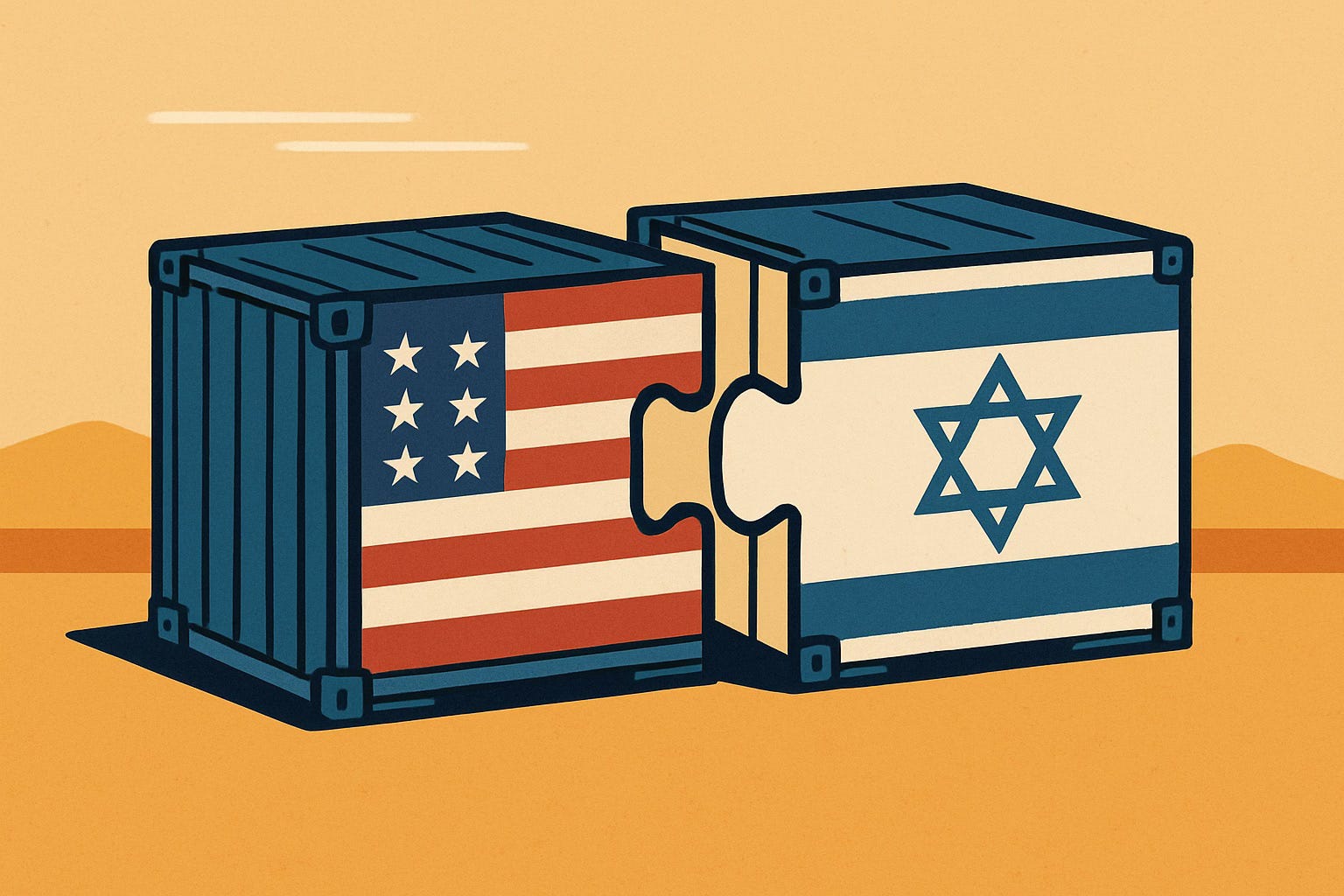
Originally published in the Times of Israel, August 8, 2025
By Josh Kram
This week, the White House imposed “reciprocal tariffs” on nearly 70 countries, including a 15% tariff on Israeli goods, effectively upending the U.S.-Israel Free Trade Agreement, signed forty years ago this month. “If it ain’t broke, don’t fix it,” a senior Israeli trade negotiator used to say to me whenever I brought up the idea of modernizing the FTA. But with a sizable trade surplus and a Trump administration laser‑focused on evening the score, Israel now faces a new paradigm for its trade relationship with the United States.
The U.S.-Israel FTA, America’s first modern free trade agreement, was signed when Israel’s largest exports were agriculture products, and the broader political winds were pushing toward globalization and trade liberalization. Today, Israel is a technology powerhouse that despite 22 months of war, is by all accounts economically thriving—the Tel Aviv stock exchange is up, the shekel has strengthened nearly 10% against the dollar, the start-up sector is doing well.
For the past several months, Israel has been in deal-making mode with its U.S. counterparts, aiming to lower its tariff rate, but so far, no deal has been reached. In the meantime, as the U.S. finalizes new trade agreements with the EU, Japan, South Korea, the UK, and others, there are important lessons for Israel–lessons that go beyond trade and are critical for strengthening the broader bilateral relationship and advancing shared economic interests.
Trade Talks Are Security Talks
U.S.-Israel trade talks over recent years have been divorced from the myriad other issues in our bilateral relationship, which predominantly focus on defense and security issues. Even before October 7th, these issues tended to crowd-out the economic agenda. While the U.S. Trade Representative pushed Israel on a number of trade issues over the years, bilateral economic matters rarely rose to the level of presidential attention. Now, trade policy is at the center of U.S. foreign policy—and being driven from the top.
As such, these agreements take into account more than just last year’s imports and exports. They incorporate a broader set of U.S. priorities, chief among them, national security. The European Commission’s trade chief said, the U.S.-EU trade deal is also “about Ukraine,” admitting that the pact was not only about trade but broader security concerns. The Trump Administration recently reversed course on both U.S. support for arms to Ukraine and its commitment to NATO.
Similarly, Israel must acknowledge that its trade deal with the U.S. will be part of a larger bargain that also takes into consideration the U.S. security assistance package and other support for Israel’s defense. Underscoring the point, when asked about the planned tariffs on Israel during Prime Minister Netanyahu’s visit in April, President Trump said: “Don’t forget, we help Israel a lot. We give Israel $4 billion a year, that’s a lot.” This support will be considered and gives USTR major leverage in the horse-trading aim for parity that seems to animate the Trump Administration’s negotiating approach.
The Baseline Rate Is the New Duty-Free
The U.S.-Israel FTA stipulated that the two countries should eliminate both duties and “other restrictive regulation of commerce on trade.” Over the years, there have been thorns in the U.S.-Israel trade relationship that have frustrated American companies such as limited market access, protectionist measures in various sectors, pesky non-tariff barriers (i.e., regulatory, standards-related, or policy measures that add cost and bureaucratic hurdles), and inadequate intellectual property protections—to name a few.
Leading up to this week’s tariff slap, Israel has been trying to claw away at the originally announced 17% rate – taking steps to liberalize the agricultural sector and address non-tariff barriers. Israel needs to continue to do this work if it’s going to achieve its best-case scenario of a 10% baseline tariff rate which is the lowest rate imposed to trading partners across the world.
Clearly, the era of unfettered U.S. market access is over… but that is only part of the story when it comes to bilateral trade.
Investment Commitments Are Critical
Recent investment announcements in U.S.—from Saudi Arabia’s $600 billion investment pledge during President Trump’s visit to the region earlier this year to the EU and Japan’s commitments to buy American energy and pour billions of dollars into U.S. manufacturing—underscore a new reality: investment is now a critical deliverable in trade negotiations. For Israel, this will require some creative messaging.
The U.S. is already Israel’s largest export market, and Israeli firms have invested an estimated $22 billion in the U.S. economy but Israel’s economy is concentrated in hi-tech rather than large‑scale manufacturing. And while it doesn’t have sovereign wealth funds or major manufacturers to deploy, it has a strong case to make: Israel is a leading R&D center for American companies. The work done in Israel fuels U.S. innovation, enhances American companies’ global competitiveness, and, in many cases, supports U.S. jobs.
The challenge (and opportunity) is for Israel to package this story in a way that lands with today’s Washington. In a Trump‑era trade paradigm that prizes bringing back U.S. manufacturing and is deeply focused on strategic competition with China, “investment” announcements from Israel could highlight U.S.-based research partnerships, expanded R&D facilities, joint ventures, and the downstream American jobs and industries they support. Cases in point: Recently, California-based Palo Alto Networks bought Israeli firm CyberArk for $25 billion and Google announced it was acquiring Wiz for $32 billion. These are two landmark deals that give U.S. companies access to some of the world’s most advanced cloud and cybersecurity technologies – critical assets amid the explosive growth in AI – and bolster American national security and economic competitiveness.
An Opportunity to Reimagine the Economic Relationship
However, Israel can’t just play defense on trade. Now is the time to put forward an ambitious bilateral economic agenda that will lay the foundation for the next forty years of partnership.
The original FTA agreement doesn’t address the wide range of sectors and issues that make up so much of our modern economy. For years, American industry groups have urged both governments to update the agreement, making it fit for a high‑tech, innovation‑driven era by adding chapters on digital trade—setting common rules for areas like AI, cybersecurity, and other emerging technologies.
An updated agreement could also break new ground as its 1985 predecessor did and broaden the economic agenda. Even without new market access, a modernized U.S.–Israel trade framework could deliver wins that speak directly to President Trump’s priorities.
First, it could help drive U.S.‑led investment in Israeli projects through tools like the U.S. International Development Finance Corporation and Export-Import Bank of the United States, ensuring American companies win contracts while partners share the costs. There are already signals that the Trump Administration has “big plans” for DFC, including allowing it to invest in high-income countries, like Israel, a major shift from its original remit to focus on emerging economies.
Second, it could establish clear rules that incentivize Gulf and other regional partners to do business with Israel, building on the Abraham Accords. While the days of using U.S. market access as leverage, as in the Qualifying Industrial Zones (QIZs), may be over, a new bilateral agreement could deploy other tools to encourage joint ventures, co‑production arrangements, and supply chain partnerships that deliver benefits to U.S. companies. This could include aligning regulations and standards—especially in the digital arena—in ways that set benchmarks other Middle Eastern countries would want to match to attract American firms and investment, alongside financial incentives for joint projects linking Israeli innovation with regional partners.
And, finally, it could open new pathways for Israeli technology to integrate into U.S. supply chains—from semiconductors to defense systems—in ways that strengthen American manufacturing, create U.S. jobs, and keep American industry globally competitive. This could include procurement provisions that make it easier for U.S. and Israeli firms to jointly bid on major defense, infrastructure, and technology contracts in the U.S. and around the world.
After signing the FTA into law, President Ronald Reagan said, “[This agreement] symbolizes once again our two countries’ deep community of interest and our shared values and aspirations for a better future. It also underscores the importance of Israel to the United States as an ally, as a trading partner, and as a friend.”
While the contours of the U.S.-Israel relationship have evolved alongside a shifting regional landscape—and with it, our trade ties—what remains clear is that America’s economic partnership with Israel will continue to serve as a cornerstone of our strategic alliance: driving innovation, promoting economic growth, and advancing the interests of both nations.
 | A guest post by
|